PYRAMIDS
PYRAMIDS
Architecture, Power, and Mystery
Architecture, Power, and Mystery
Architecture, Power, and Mystery
I. Pyramid Architecture
I. Pyramid Architecture
I. Pyramid Architecture
From tomb evolution to perfected form, engineering logic meets symbolism.
II. Monuments and Power
II. Monuments and Power
II. Monuments and Power
How architecture materializes authority, commands labor, and communicates power eternally.
III.The Colonial Imagination
III.The Colonial Imagination
III.The Colonial Imagination
How empires reinterpreted pyramids to legitimize conquest, anxiety, identity formation.
IV. The Sublime and the Sacred
IV. The Sublime and the Sacred
IV. The Sublime and the Sacred
Why overwhelming scale triggers awe, terror, transcendence across cultures universally.
V.The Science of Permanence
V.The Science of Permanence
V.The Science of Permanence
Engineering decisions that enabled pyramids to endure millennia without maintenance.
Engineering decisions that enabled pyramids to endure millennia without maintenance.
VI. Sacred Geometry and Exactitude
VI. Sacred Geometry and Exactitude
VI. Sacred Geometry and Exactitude
How geometry, astronomy, and craft encoded divinity into precise architecture.
VII.The Mystery Industrial Complex
VII.The Mystery Industrial Complex
VII.The Mystery Industrial Complex
Why mystery, conspiracy, and spectacle thrive despite overwhelming archaeological evidence.
Why mystery, conspiracy, and spectacle thrive despite overwhelming archaeological evidence.
I. Pyramid Architecture
I. Pyramid Architecture
I. Pyramid Architecture
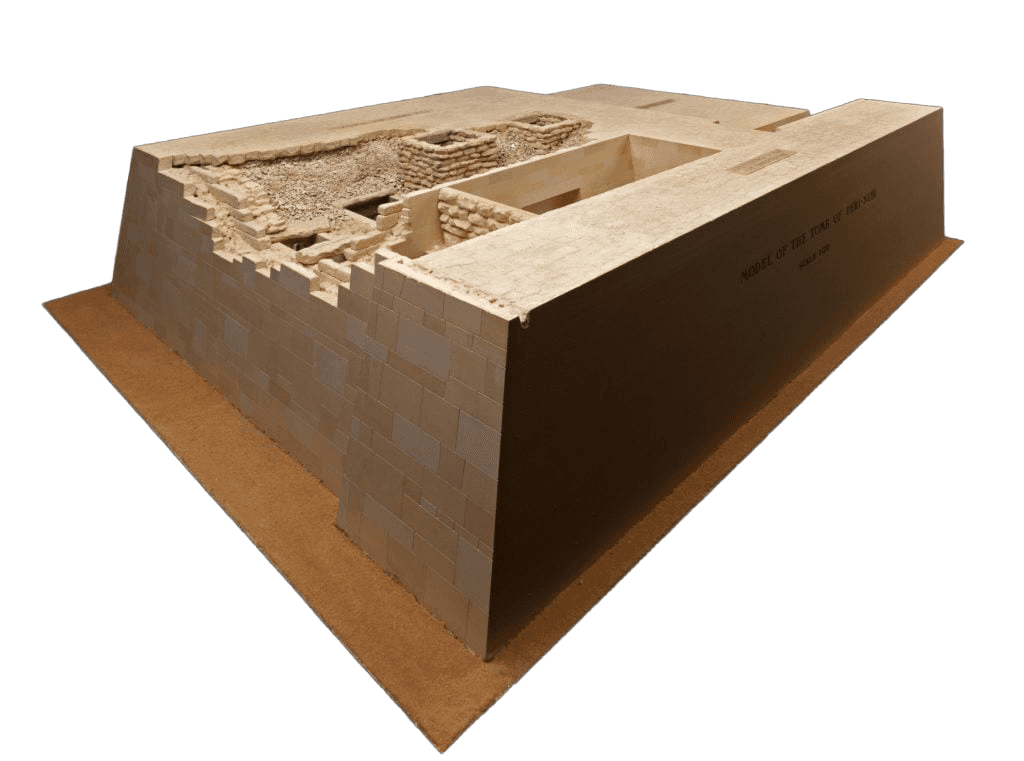
Late in Dynasty 5, the palace administrator Perneb built a tomb at Saqqara, twenty miles south of Giza. The tomb included an underground burial chamber and a limestone building called a mastaba. - Source
Late in Dynasty 5, the palace administrator Perneb built a tomb at Saqqara, twenty miles south of Giza. The tomb included an underground burial chamber and a limestone building called a mastaba. - Source
Late in Dynasty 5, the palace administrator Perneb built a tomb at Saqqara, twenty miles south of Giza. The tomb included an underground burial chamber and a limestone building called a mastaba. - Source
Early Egyptian rulers faced a fundamental architectural problem: how to create a tomb that would physically embody their divine status and ensure their eternal legacy? The traditional mastaba tombs, low rectangular structures made from mud brick, were adequate for nobles but insufficient for expressing pharaonic power. These structures were temporary, modest in scale, and vulnerable to the elements. So the question came up: how do you create a structure so monumental, so permanent, that it commands reverence for thousands of years?
The Solution: Around 2700 BCE, Egyptian architecture underwent a radical transformation that answered this challenge through a series of innovations in material and form.
Early Egyptian rulers faced a fundamental architectural problem: how to create a tomb that would physically embody their divine status and ensure their eternal legacy? The traditional mastaba tombs, low rectangular structures made from mud brick, were adequate for nobles but insufficient for expressing pharaonic power. These structures were temporary, modest in scale, and vulnerable to the elements. So the question came up: how do you create a structure so monumental, so permanent, that it commands reverence for thousands of years?
The Solution: Around 2700 BCE, Egyptian architecture underwent a radical transformation that answered this challenge through a series of innovations in material and form.
Early Egyptian rulers faced a fundamental architectural problem: how to create a tomb that would physically embody their divine status and ensure their eternal legacy? The traditional mastaba tombs, low rectangular structures made from mud brick, were adequate for nobles but insufficient for expressing pharaonic power. These structures were temporary, modest in scale, and vulnerable to the elements. So the question came up: how do you create a structure so monumental, so permanent, that it commands reverence for thousands of years?
The Solution: Around 2700 BCE, Egyptian architecture underwent a radical transformation that answered this challenge through a series of innovations in material and form.
The Pyramidal Shape
The independent development of pyramid forms across cultures suggests this shape solves universal architectural problems better than alternatives. Understanding why requires examining the geometric, structural, and symbolic advantages that make pyramids optimal solutions for monumental architecture.
Structural logic:
From an engineering perspective, the pyramid is perfect for massive construction. They have:
A wide base distributes weight efficiently
Minimal internal support needed
Resistance to earthquakes and erosion
As the structure rises, each level is smaller and lighter than the one below, creating a natural tapering that ensures the structure never bears more weight than its materials can support. The triangular profile resists lateral forces from wind and earthquakes. There's no large flat surface for wind to push against, and the low center of gravity prevents toppling. The pyramid is essentially a solid mass that makes structural failure nearly impossible.
The Pyramidal Shape
The independent development of pyramid forms across cultures suggests this shape solves universal architectural problems better than alternatives. Understanding why requires examining the geometric, structural, and symbolic advantages that make pyramids optimal solutions for monumental architecture.
Structural logic:
From an engineering perspective, the pyramid is perfect for massive construction. They have:
A wide base distributes weight efficiently
Minimal internal support needed
Resistance to earthquakes and erosion
As the structure rises, each level is smaller and lighter than the one below, creating a natural tapering that ensures the structure never bears more weight than its materials can support. The triangular profile resists lateral forces from wind and earthquakes. There's no large flat surface for wind to push against, and the low center of gravity prevents toppling. The pyramid is essentially a solid mass that makes structural failure nearly impossible.
The Pyramidal Shape
The independent development of pyramid forms across cultures suggests this shape solves universal architectural problems better than alternatives. Understanding why requires examining the geometric, structural, and symbolic advantages that make pyramids optimal solutions for monumental architecture.
Structural logic:
From an engineering perspective, the pyramid is perfect for massive construction. They have:
A wide base distributes weight efficiently
Minimal internal support needed
Resistance to earthquakes and erosion
As the structure rises, each level is smaller and lighter than the one below, creating a natural tapering that ensures the structure never bears more weight than its materials can support. The triangular profile resists lateral forces from wind and earthquakes. There's no large flat surface for wind to push against, and the low center of gravity prevents toppling. The pyramid is essentially a solid mass that makes structural failure nearly impossible.
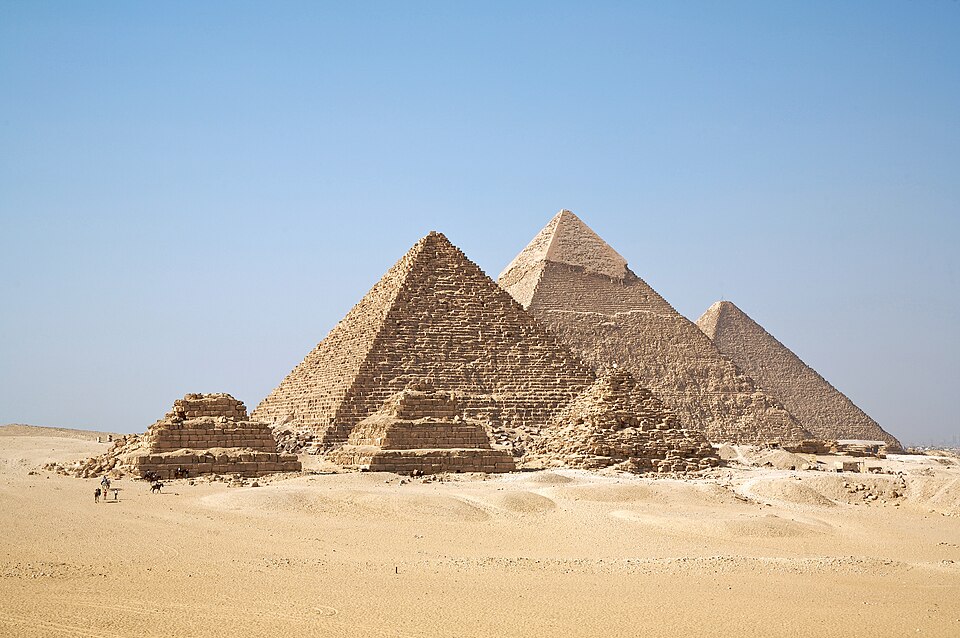
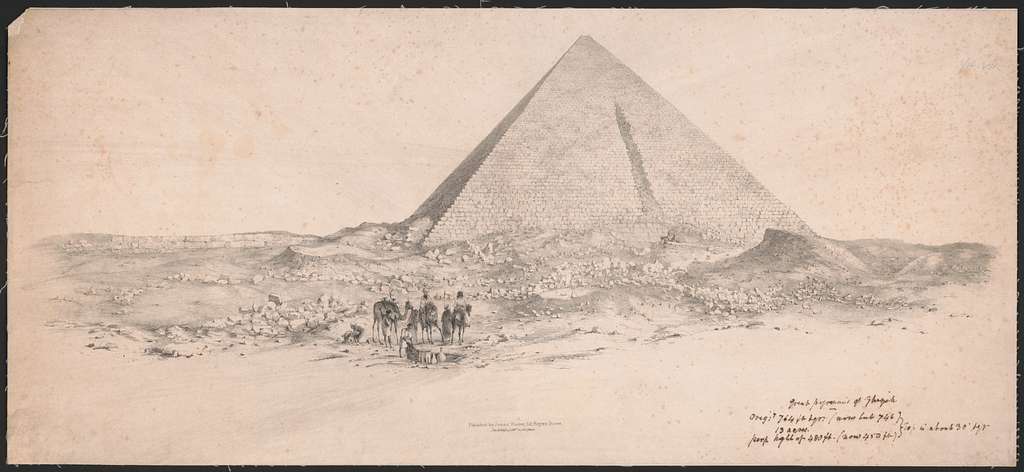
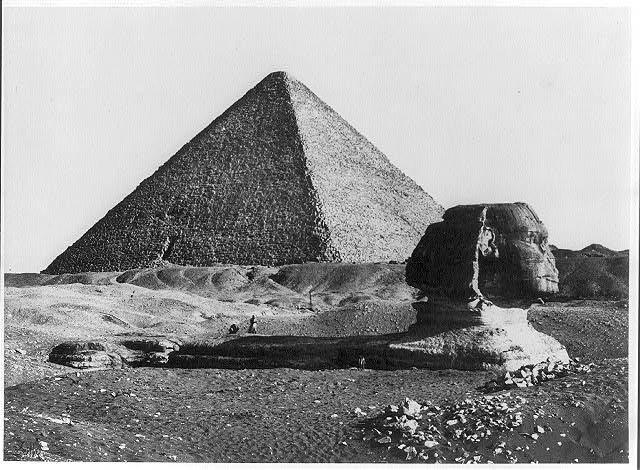
Wide photograph of the Giza pyramid complex dominating the surrounding desert, emphasizing monumental scale, geometric clarity, and landscape control that visually communicates political authority, cosmic order, and symbolic power.- Source
Wide photograph of the Giza pyramid complex dominating the surrounding desert, emphasizing monumental scale, geometric clarity, and landscape control that visually communicates political authority, cosmic order, and symbolic power.- Source
Wide photograph of the Giza pyramid complex dominating the surrounding desert, emphasizing monumental scale, geometric clarity, and landscape control that visually communicates political authority, cosmic order, and symbolic power.- Source
Symbolic power:
Symbolically, the pyramid's form communicates specific messages across cultures. The apex pointing skyward creates a visual connection between earth and sky, making the structure a physical manifestation of the axis mundi, the cosmic axis connecting different realms of existence. The simplicity is also remarkable; four triangles meeting at a point, suggesting fundamental truth and eternal principles rather than human artifice. The visibility from great distances ensures the structure dominates its landscape, continuously reminding viewers of the power behind its construction.
Construction practicality:
From a practical standpoint, pyramids are remarkably buildable despite their scale. They
Can be built without advanced mathematics
Each level provides platform for next level
Easy to survey and plan
Yet, they underwent a sequence of problem-solving iterations for perfection through centuries.
Symbolic power:
Symbolically, the pyramid's form communicates specific messages across cultures. The apex pointing skyward creates a visual connection between earth and sky, making the structure a physical manifestation of the axis mundi, the cosmic axis connecting different realms of existence. The simplicity is also remarkable; four triangles meeting at a point, suggesting fundamental truth and eternal principles rather than human artifice. The visibility from great distances ensures the structure dominates its landscape, continuously reminding viewers of the power behind its construction.
Construction practicality:
From a practical standpoint, pyramids are remarkably buildable despite their scale. They
Can be built without advanced mathematics
Each level provides platform for next level
Easy to survey and plan
Yet, they underwent a sequence of problem-solving iterations for perfection through centuries.
First Attempt: The Step Pyramid of Djoser
The Step Pyramid of Djoser at Saqqara, designed by history's first named architect Imhotep, represented humanity's first massive stone structure which was six terraces stacked skyward, visible for miles. It's key architectural innovations were:
Transition from mud brick (mastabas) to limestone construction
Vertical monumentality: 62 meters high!
First structure designed to last beyond temporary use
This wasn't merely a larger tomb, it was a fundamental reimagining of what architecture could be. By transitioning from organic materials to stone, Imhotep created a new architectural language of permanence. The vertical stacking of terraces solved multiple problems simultaneously: it created unprecedented height for visibility, suggested a stairway to the heavens that aligned with Egyptian cosmology, and distributed the massive weight of stone in a structurally stable configuration.
First Attempt: The Step Pyramid of Djoser
The Step Pyramid of Djoser at Saqqara, designed by history's first named architect Imhotep, represented humanity's first massive stone structure which was six terraces stacked skyward, visible for miles. It's key architectural innovations were:
Transition from mud brick (mastabas) to limestone construction
Vertical monumentality: 62 meters high!
First structure designed to last beyond temporary use
This wasn't merely a larger tomb, it was a fundamental reimagining of what architecture could be. By transitioning from organic materials to stone, Imhotep created a new architectural language of permanence. The vertical stacking of terraces solved multiple problems simultaneously: it created unprecedented height for visibility, suggested a stairway to the heavens that aligned with Egyptian cosmology, and distributed the massive weight of stone in a structurally stable configuration.
First Attempt: The Step Pyramid of Djoser
The Step Pyramid of Djoser at Saqqara, designed by history's first named architect Imhotep, represented humanity's first massive stone structure which was six terraces stacked skyward, visible for miles. It's key architectural innovations were:
Transition from mud brick (mastabas) to limestone construction
Vertical monumentality: 62 meters high!
First structure designed to last beyond temporary use
This wasn't merely a larger tomb, it was a fundamental reimagining of what architecture could be. By transitioning from organic materials to stone, Imhotep created a new architectural language of permanence. The vertical stacking of terraces solved multiple problems simultaneously: it created unprecedented height for visibility, suggested a stairway to the heavens that aligned with Egyptian cosmology, and distributed the massive weight of stone in a structurally stable configuration.
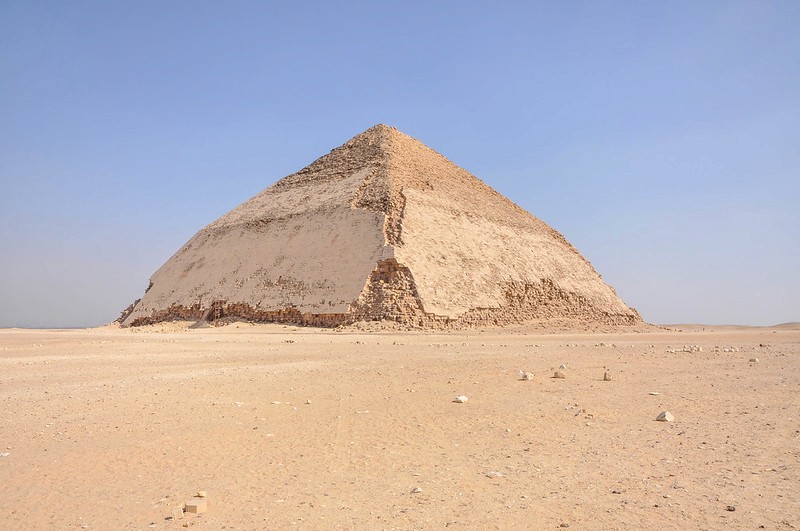
The Bent Pyramid represents a change from the step-sided pyramids of before to smooth-sided pyramids. It has been suggested that due to the steepness of the original angle of inclination the structure may have begun to show signs of instability during construction - Source
The Bent Pyramid represents a change from the step-sided pyramids of before to smooth-sided pyramids. It has been suggested that due to the steepness of the original angle of inclination the structure may have begun to show signs of instability during construction - Source
The Bent Pyramid represents a change from the step-sided pyramids of before to smooth-sided pyramids. It has been suggested that due to the steepness of the original angle of inclination the structure may have begun to show signs of instability during construction - Source
Once the principle of stone pyramid construction was established, Egyptian architects evolved from stepped pyramids to the aesthetically ideal form of smooth-sided true pyramids. The geometric perfection of unbroken triangular sides held both symbolic meaning (representing sun rays) and engineering challenges. The critical question was: what angle could support a smooth-sided pyramid at monumental scale without structural failure?
Pharaoh Sneferu's Bent Pyramid documents trial and error in real time. Builders started with a steep angle but realized midway the structure would collapse under its own weight. Rather than abandon the project, they adjusted by changing the slope and creating the distinctive "bent" silhouette.
Once the principle of stone pyramid construction was established, Egyptian architects evolved from stepped pyramids to the aesthetically ideal form of smooth-sided true pyramids. The geometric perfection of unbroken triangular sides held both symbolic meaning (representing sun rays) and engineering challenges. The critical question was: what angle could support a smooth-sided pyramid at monumental scale without structural failure?
Pharaoh Sneferu's Bent Pyramid documents trial and error in real time. Builders started with a steep angle but realized midway the structure would collapse under its own weight. Rather than abandon the project, they adjusted by changing the slope and creating the distinctive "bent" silhouette.
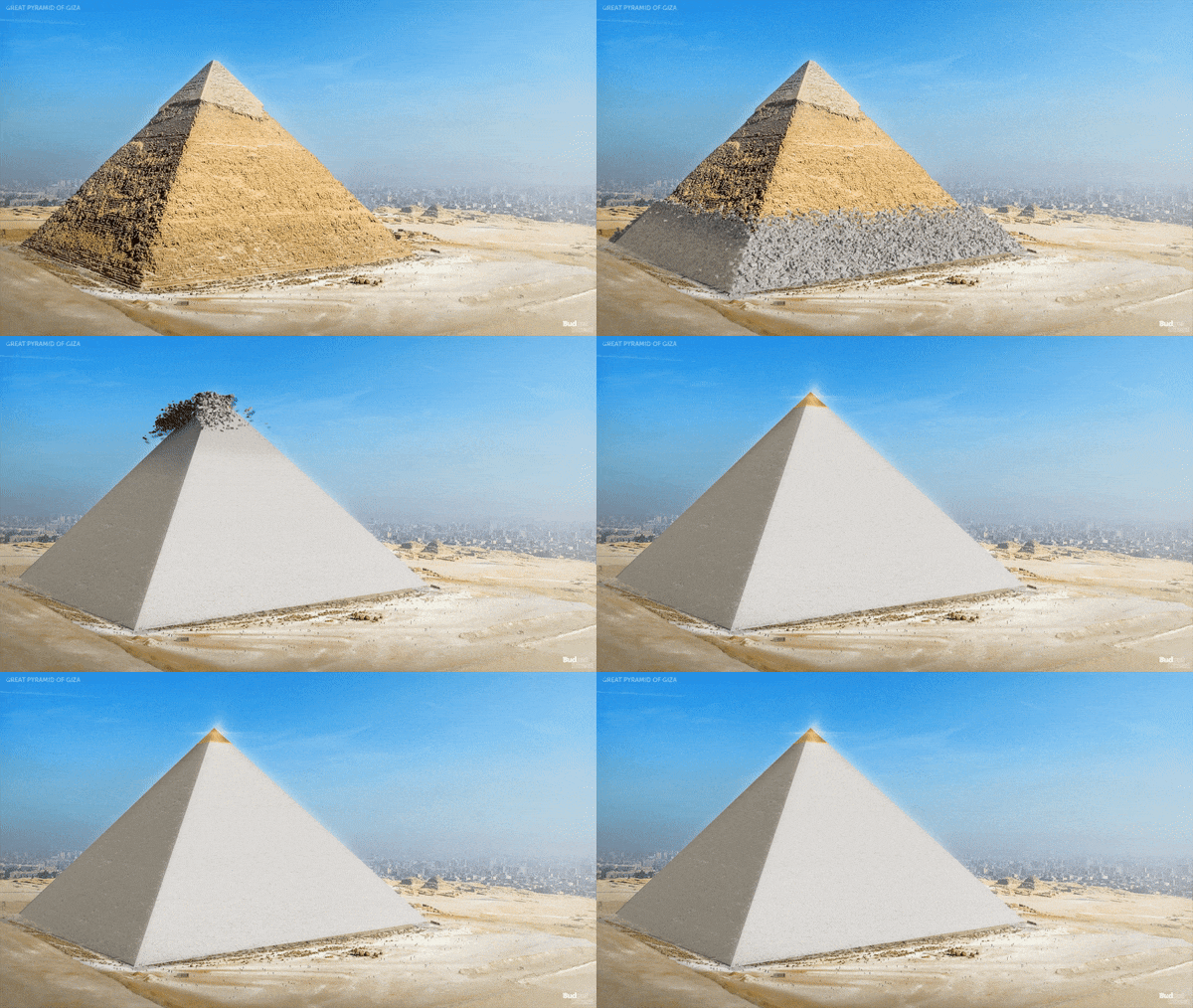
A reconstructed view of the Great Pyramid of Giza, shown with its original white limestone casing and a gilded capstone. Commissioned as a royal tomb for the Egyptian pharaoh Khufu, the pyramid was constructed between approximately 2584 and 2561 BCE and stands as one of the Seven Wonders of the Ancient World. - Source
A reconstructed view of the Great Pyramid of Giza, shown with its original white limestone casing and a gilded capstone. Commissioned as a royal tomb for the Egyptian pharaoh Khufu, the pyramid was constructed between approximately 2584 and 2561 BCE and stands as one of the Seven Wonders of the Ancient World. - Source
A reconstructed view of the Great Pyramid of Giza, shown with its original white limestone casing and a gilded capstone. Commissioned as a royal tomb for the Egyptian pharaoh Khufu, the pyramid was constructed between approximately 2584 and 2561 BCE and stands as one of the Seven Wonders of the Ancient World. - Source
Mastering the Form: The Red Pyramid
Having identified the structural problem with steep angles through the Bent Pyramid experience, Sneferu's architects needed to determine the optimal angle that could support a true pyramid from base to apex. This required calculating the relationship between height, base width, and slope to ensure structural integrity while maintaining impressive scale.
Sneferu's second attempt, the Red Pyramid, achieved smooth, unbroken sides from base to apex, the first true pyramid. The 43-degree angle became the standard for structural stability.
This seemingly simple achievement, maintaining a consistent angle throughout, represents a sophisticated understanding of load distribution, material properties, and geometric relationships. The 43-degree slope provided enough height for visual impact while ensuring each stone course could support the weight above it without exceeding the compression strength of limestone.
Mastering the Form: The Red Pyramid
Having identified the structural problem with steep angles through the Bent Pyramid experience, Sneferu's architects needed to determine the optimal angle that could support a true pyramid from base to apex. This required calculating the relationship between height, base width, and slope to ensure structural integrity while maintaining impressive scale.
Sneferu's second attempt, the Red Pyramid, achieved smooth, unbroken sides from base to apex, the first true pyramid. The 43-degree angle became the standard for structural stability.
This seemingly simple achievement, maintaining a consistent angle throughout, represents a sophisticated understanding of load distribution, material properties, and geometric relationships. The 43-degree slope provided enough height for visual impact while ensuring each stone course could support the weight above it without exceeding the compression strength of limestone.
Mastering the Form: The Red Pyramid
Having identified the structural problem with steep angles through the Bent Pyramid experience, Sneferu's architects needed to determine the optimal angle that could support a true pyramid from base to apex. This required calculating the relationship between height, base width, and slope to ensure structural integrity while maintaining impressive scale.
Sneferu's second attempt, the Red Pyramid, achieved smooth, unbroken sides from base to apex, the first true pyramid. The 43-degree angle became the standard for structural stability.
This seemingly simple achievement, maintaining a consistent angle throughout, represents a sophisticated understanding of load distribution, material properties, and geometric relationships. The 43-degree slope provided enough height for visual impact while ensuring each stone course could support the weight above it without exceeding the compression strength of limestone.
By the time Pharaoh Khufu commissioned his pyramid, Egyptian architects had accumulated decades of structural knowledge. However, Khufu's ambition created a new challenge: building at a scale that exceeded all previous attempts while achieving levels of precision that would demonstrate absolute mastery. The engineering problem was multifaceted: maintain geometric accuracy across millions of blocks, align a massive structure to celestial directions, level a foundation across acres of uneven bedrock, and do all of this while coordinating tens of thousands of workers over decades.
Khufu's Great Pyramid at Giza (c. 2580-2560 BCE) remained Earth's tallest structure for 4,000 years. Its precision rivals modern surveying equipment, but was achieved with Bronze Age tools. The alignment to true north required astronomical observation methods sophisticated enough to compete with magnetic compasses (which hadn't been invented). The level base required excavating bedrock and using water-leveling techniques across massive distances. The tight-fitting joints required custom-shaping each block to match its neighbors while maintaining overall structural integrity. This convergence of solutions, material science, surveying, logistics, quality control, represents ancient Egypt's peak architectural achievement.
By the time Pharaoh Khufu commissioned his pyramid, Egyptian architects had accumulated decades of structural knowledge. However, Khufu's ambition created a new challenge: building at a scale that exceeded all previous attempts while achieving levels of precision that would demonstrate absolute mastery. The engineering problem was multifaceted: maintain geometric accuracy across millions of blocks, align a massive structure to celestial directions, level a foundation across acres of uneven bedrock, and do all of this while coordinating tens of thousands of workers over decades.
Khufu's Great Pyramid at Giza (c. 2580-2560 BCE) remained Earth's tallest structure for 4,000 years. Its precision rivals modern surveying equipment, but was achieved with Bronze Age tools. The alignment to true north required astronomical observation methods sophisticated enough to compete with magnetic compasses (which hadn't been invented). The level base required excavating bedrock and using water-leveling techniques across massive distances. The tight-fitting joints required custom-shaping each block to match its neighbors while maintaining overall structural integrity. This convergence of solutions, material science, surveying, logistics, quality control, represents ancient Egypt's peak architectural achievement.
Architecture from Progression
The pharaohs succeeded in capturing the imagination of the future. We're still studying Pyramids, still stand in awe in their shadows, 4,500 years later. The progression from Djoser's Step Pyramid through the Bent Pyramid to the Great Pyramid reveals a methodology we now call iterative design: build, test, observe, refine, rebuild. Each structure represented an experiment at massive scale, with real-world feedback directly informing the next project. This approach created institutional knowledge that accumulated across generations, with each architect building on the lessons learned by predecessors.
Architecture from Progression
The pharaohs succeeded in capturing the imagination of the future. We're still studying Pyramids, still stand in awe in their shadows, 4,500 years later. The progression from Djoser's Step Pyramid through the Bent Pyramid to the Great Pyramid reveals a methodology we now call iterative design: build, test, observe, refine, rebuild. Each structure represented an experiment at massive scale, with real-world feedback directly informing the next project. This approach created institutional knowledge that accumulated across generations, with each architect building on the lessons learned by predecessors.
Architecture from Progression
The pharaohs succeeded in capturing the imagination of the future. We're still studying Pyramids, still stand in awe in their shadows, 4,500 years later. The progression from Djoser's Step Pyramid through the Bent Pyramid to the Great Pyramid reveals a methodology we now call iterative design: build, test, observe, refine, rebuild. Each structure represented an experiment at massive scale, with real-world feedback directly informing the next project. This approach created institutional knowledge that accumulated across generations, with each architect building on the lessons learned by predecessors.
“Perfection emerges through repetition. Each built work tests assumptions, informs the next, and advances knowledge through making.”
“Perfection emerges through repetition. Each built work tests assumptions, informs the next, and advances knowledge through making.”
II. Monuments and Power
II. Monuments and Power
The Language of Permanence
Throughout history, rulers have faced the political challenge of legitimizing their authority and ensuring their legacy beyond their lifetime. Words can be forgotten, laws can be changed, and memories fade within generations. Demonstrating power through military might, wealth distribution, and administrative control works only during a ruler's life and immediate aftermath. How, then, do you create a physical statement of power so overwhelming, so permanent, that it continues communicating authority millennia after your death?
The Solution: When a pharaoh mobilizes tens of thousands of workers to build a pyramid, he demonstrates his ability to command resources, organize labor, and bend nature to his will. The pyramid is a physical manifestation of political power. It is impossible to ignore, impossible to forget.
This approach to architecture as political communication solves multiple problems simultaneously. First, the sheer resource investment proves economic capacity; only a truly wealthy state can divert this much labor and material to non-productive uses. Second, the organizational complexity demonstrates administrative sophistication. Coordinating tens of thousands of workers across decades requires bureaucratic systems not individual administrators. Third, the permanent nature of stone ensures the message persists independent of living memory, continuously reinforcing the power of the pharaoh's lineage. Finally, the monumental scale creates a psychological impact that abstract declarations of power cannot match. Standing before a 140-meter structure triggers physiological responses that establish authority at a visceral, non-rational level.
The Language of Permanence
Throughout history, rulers have faced the political challenge of legitimizing their authority and ensuring their legacy beyond their lifetime. Words can be forgotten, laws can be changed, and memories fade within generations. Demonstrating power through military might, wealth distribution, and administrative control works only during a ruler's life and immediate aftermath. How, then, do you create a physical statement of power so overwhelming, so permanent, that it continues communicating authority millennia after your death?
The Solution: When a pharaoh mobilizes tens of thousands of workers to build a pyramid, he demonstrates his ability to command resources, organize labor, and bend nature to his will. The pyramid is a physical manifestation of political power. It is impossible to ignore, impossible to forget.
This approach to architecture as political communication solves multiple problems simultaneously. First, the sheer resource investment proves economic capacity; only a truly wealthy state can divert this much labor and material to non-productive uses. Second, the organizational complexity demonstrates administrative sophistication. Coordinating tens of thousands of workers across decades requires bureaucratic systems not individual administrators. Third, the permanent nature of stone ensures the message persists independent of living memory, continuously reinforcing the power of the pharaoh's lineage. Finally, the monumental scale creates a psychological impact that abstract declarations of power cannot match. Standing before a 140-meter structure triggers physiological responses that establish authority at a visceral, non-rational level.
Defensive Design
Throughout history, conquering powers have attempted to destroy monuments left by previous rulers, both to access valuable building materials and to eliminate symbols of competing authority. The architectural question becomes: can a structure be designed not just to stand for centuries, but to actively resist attempts at demolition?
The pyramids' engineering creates an unexpected defensive capability. They're easier to build than to destroy, as demonstrated by a Sultan's attempts to destroy a Pyramid.
Defensive Design
Throughout history, conquering powers have attempted to destroy monuments left by previous rulers, both to access valuable building materials and to eliminate symbols of competing authority. The architectural question becomes: can a structure be designed not just to stand for centuries, but to actively resist attempts at demolition?
The pyramids' engineering creates an unexpected defensive capability. They're easier to build than to destroy, as demonstrated by a Sultan's attempts to destroy a Pyramid.
Defensive Design
Throughout history, conquering powers have attempted to destroy monuments left by previous rulers, both to access valuable building materials and to eliminate symbols of competing authority. The architectural question becomes: can a structure be designed not just to stand for centuries, but to actively resist attempts at demolition?
The pyramids' engineering creates an unexpected defensive capability. They're easier to build than to destroy, as demonstrated by a Sultan's attempts to destroy a Pyramid.
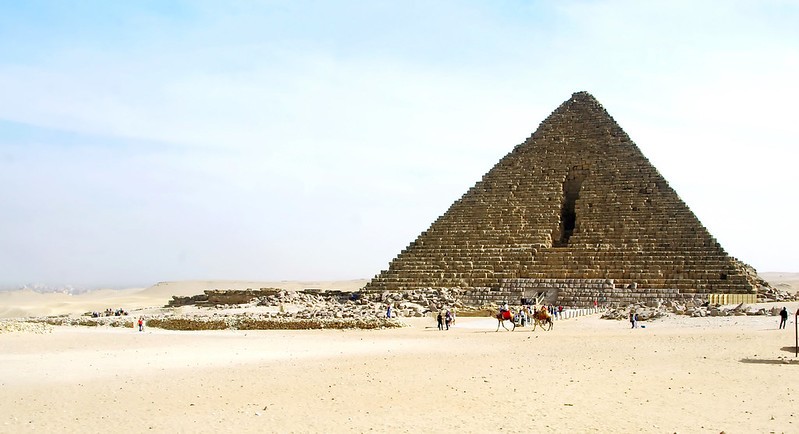
Eight months work resulted in this vertical gash on the northern face of the Pyramid of Menkaure.
Eight months work resulted in this vertical gash on the northern face of the Pyramid of Menkaure.
The Ayyubid sultan decided to demolish the pyramids at Giza for building materials or to eliminate symbols of polytheism but ultimately abandoned the project. Each massive stone block, once dropped, sank deep into sand. Extracting them required teams of oxen, wooden levers, and backbreaking labor. The vertical gash on the Pyramid of Menkaure remains today, ironically memorializing his failure.
The pyramids solved the demolition problem through several design features. First, the massive weight of individual blocks creates a practical barrier—each stone requires enormous effort to move even once dislodged. Second, the interlocking structure means removing one block doesn't trigger cascade failure—the remaining structure maintains integrity, requiring individual attention to each stone. Third, the solid mass construction means there's no easy way to attack structural weak points. Unlike columned buildings where removing key supports causes collapse, pyramids distribute load so evenly that targeted demolition is ineffective. Finally, the desert location means dropped blocks immediately sink into sand, adding the additional labor of excavation to every stone removed. This combination of factors makes systematic demolition prohibitively expensive, even for powerful rulers with ideological motivations.
The pyramids weren't just well-built; they were weaponized architecture. They were designed to outlast and challenge future powers.
The Ayyubid sultan decided to demolish the pyramids at Giza for building materials or to eliminate symbols of polytheism but ultimately abandoned the project. Each massive stone block, once dropped, sank deep into sand. Extracting them required teams of oxen, wooden levers, and backbreaking labor. The vertical gash on the Pyramid of Menkaure remains today, ironically memorializing his failure.
The pyramids solved the demolition problem through several design features. First, the massive weight of individual blocks creates a practical barrier—each stone requires enormous effort to move even once dislodged. Second, the interlocking structure means removing one block doesn't trigger cascade failure—the remaining structure maintains integrity, requiring individual attention to each stone. Third, the solid mass construction means there's no easy way to attack structural weak points. Unlike columned buildings where removing key supports causes collapse, pyramids distribute load so evenly that targeted demolition is ineffective. Finally, the desert location means dropped blocks immediately sink into sand, adding the additional labor of excavation to every stone removed. This combination of factors makes systematic demolition prohibitively expensive, even for powerful rulers with ideological motivations.
The pyramids weren't just well-built; they were weaponized architecture. They were designed to outlast and challenge future powers.
Pyramids as Political Theater
The Construction Ritual
Beyond the completed structure, the construction process itself served crucial political functions. A pyramid project created continuous public spectacle over decades, ensuring every generation experienced direct evidence of pharaonic power. The challenge was transforming construction logistics into political communication.
Pyramids as Political Theater
The Construction Ritual
Beyond the completed structure, the construction process itself served crucial political functions. A pyramid project created continuous public spectacle over decades, ensuring every generation experienced direct evidence of pharaonic power. The challenge was transforming construction logistics into political communication.
Pyramids as Political Theater
The Construction Ritual
Beyond the completed structure, the construction process itself served crucial political functions. A pyramid project created continuous public spectacle over decades, ensuring every generation experienced direct evidence of pharaonic power. The challenge was transforming construction logistics into political communication.
Nation building:
Projects lasted decades, so every generation witnessed royal power
Scale demonstrated organizational capability over time
Worksites became pilgrimage destinations
The extended timeline solved a succession problem: A project spanning decades means multiple generations see it, creating continuity that transcends individual pharaohs' reigns. Citizens couldn't remember a time "before the pyramid," making royal power seem eternal rather than contingent.
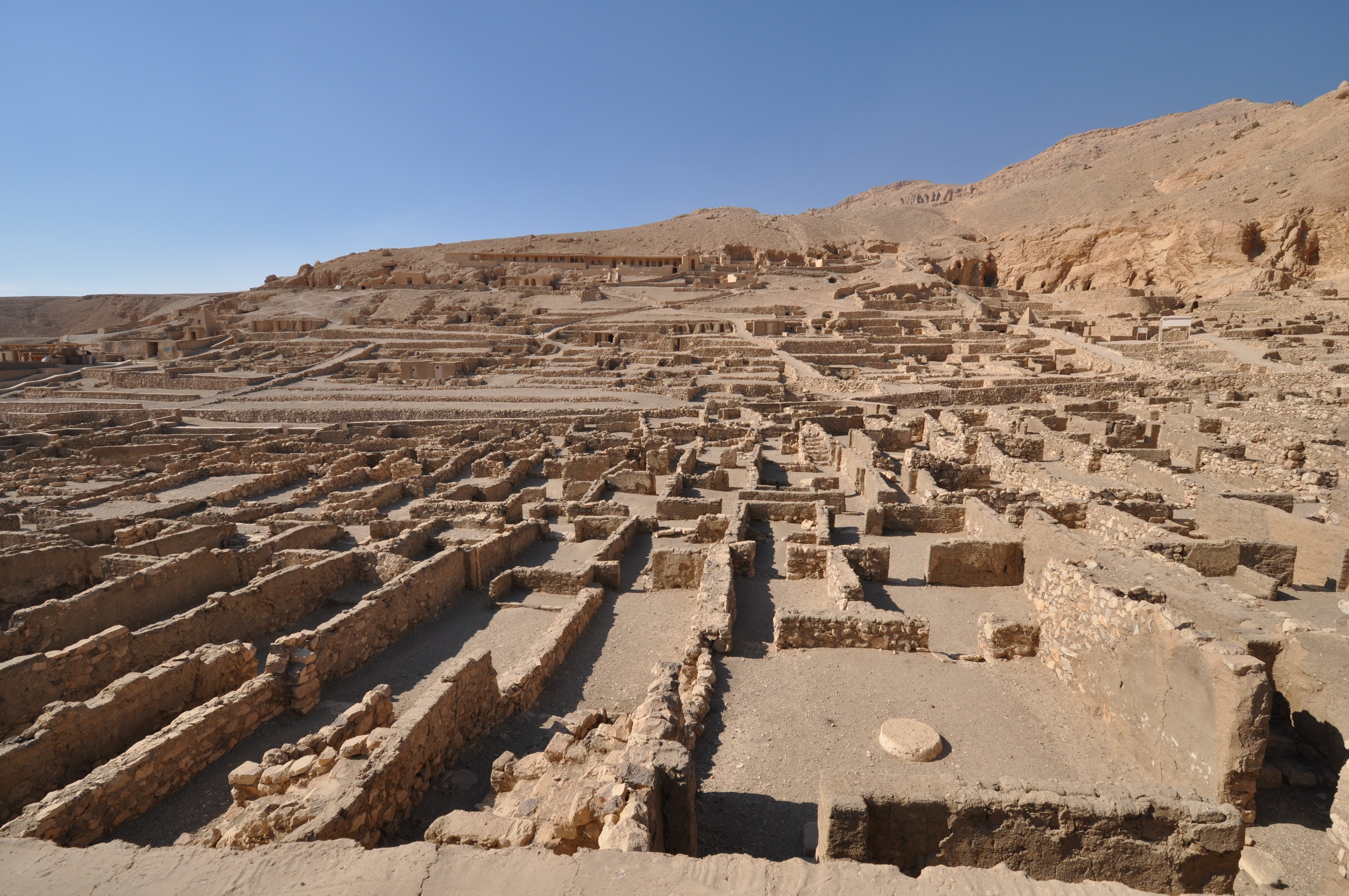
Deir el-Medina is the modern Arabic name for the worker's village. They housed the artisans and craftsmen who built the royal tombs in the nearby Valley of the Kings and Valley of the Queens. - Source
Deir el-Medina is the modern Arabic name for the worker's village. They housed the artisans and craftsmen who built the royal tombs in the nearby Valley of the Kings and Valley of the Queens. - Source
Employment:
Most workers were paid laborers, not slaves
Archaeological evidence shows workers' villages with medical care and nutrition
Pyramid projects provided employment during Nile flood season
The employment strategy solved multiple problems simultaneously. During Nile flood seasons when agricultural work was impossible, pyramid construction absorbed surplus labor that might otherwise create social instability. By paying workers rather than enslaving them, pharaohs created economic investment in the project's success, with workers' pride and economic dependence aligning their interests with completing the royal vision.
Employment:
Most workers were paid laborers, not slaves
Archaeological evidence shows workers' villages with medical care and nutrition
Pyramid projects provided employment during Nile flood season
The employment strategy solved multiple problems simultaneously. During Nile flood seasons when agricultural work was impossible, pyramid construction absorbed surplus labor that might otherwise create social instability. By paying workers rather than enslaving them, pharaohs created economic investment in the project's success, with workers' pride and economic dependence aligning their interests with completing the royal vision.
Employment:
Most workers were paid laborers, not slaves
Archaeological evidence shows workers' villages with medical care and nutrition
Pyramid projects provided employment during Nile flood season
The employment strategy solved multiple problems simultaneously. During Nile flood seasons when agricultural work was impossible, pyramid construction absorbed surplus labor that might otherwise create social instability. By paying workers rather than enslaving them, pharaohs created economic investment in the project's success, with workers' pride and economic dependence aligning their interests with completing the royal vision.
Religious legitimacy:
Connected pharaoh to gods
Demonstrated divine favor
Pyramid as sacred architecture reinforced theocratic power
By framing pyramid construction as religious obligation rather than merely personal aggrandizement, pharaohs positioned themselves as essential intermediaries between human and divine realms. The successful completion of such massive projects "proved" divine favor.
Religious legitimacy:
Connected pharaoh to gods
Demonstrated divine favor
Pyramid as sacred architecture reinforced theocratic power
By framing pyramid construction as religious obligation rather than merely personal aggrandizement, pharaohs positioned themselves as essential intermediaries between human and divine realms. The successful completion of such massive projects "proved" divine favor.
Religious legitimacy:
Connected pharaoh to gods
Demonstrated divine favor
Pyramid as sacred architecture reinforced theocratic power
By framing pyramid construction as religious obligation rather than merely personal aggrandizement, pharaohs positioned themselves as essential intermediaries between human and divine realms. The successful completion of such massive projects "proved" divine favor.
The Psychology of Scale
The Perceptual Challenge: Architects deliberately manipulated human perception to achieve political and religious goals. What specific architectural strategies trigger the psychological responses that establish authority?
Embodied experience:
When confronting truly massive structures, the human body provides immediate feedback that establishes the building's dominance.
Human scale disappears confronting 140-meter structures
Physical discomfort creates psychological impact
Body's smallness becomes impossible to ignore
The Psychology of Scale
The Perceptual Challenge: Architects deliberately manipulated human perception to achieve political and religious goals. What specific architectural strategies trigger the psychological responses that establish authority?
Embodied experience:
When confronting truly massive structures, the human body provides immediate feedback that establishes the building's dominance.
Human scale disappears confronting 140-meter structures
Physical discomfort creates psychological impact
Body's smallness becomes impossible to ignore
The Psychology of Scale
The Perceptual Challenge: Architects deliberately manipulated human perception to achieve political and religious goals. What specific architectural strategies trigger the psychological responses that establish authority?
Embodied experience:
When confronting truly massive structures, the human body provides immediate feedback that establishes the building's dominance.
Human scale disappears confronting 140-meter structures
Physical discomfort creates psychological impact
Body's smallness becomes impossible to ignore
Peripheral vision cannot capture the entire structure simultaneously, forcing the viewer to move or turn. The building dictates your physical behavior. These responses operates below conscious reasoning, making it powerful propaganda that doesn't require literacy or cultural knowledge to comprehend.
Spatial domination:
The spatial impact solves the problem of maintaining presence across distance. Unlike human authorities who can only be in one place at a time, monumental architecture remains visible across vast areas, creating omnipresent reminders of power.
Visible from miles away (inescapable presence) and reorganizes landscape
Controls sight lines and movement through space
The enormity of the Pyramids reorganizes the landscape itself, becoming the reference point by which everything else is oriented "north of the pyramid," "three days' walk from the great temple." This controls not just physical navigation but mental maps, ensuring the monument occupies central position in how people conceptualize their world.
Peripheral vision cannot capture the entire structure simultaneously, forcing the viewer to move or turn. The building dictates your physical behavior. These responses operates below conscious reasoning, making it powerful propaganda that doesn't require literacy or cultural knowledge to comprehend.
Spatial domination:
The spatial impact solves the problem of maintaining presence across distance. Unlike human authorities who can only be in one place at a time, monumental architecture remains visible across vast areas, creating omnipresent reminders of power.
Visible from miles away (inescapable presence) and reorganizes landscape
Controls sight lines and movement through space
The enormity of the Pyramids reorganizes the landscape itself, becoming the reference point by which everything else is oriented "north of the pyramid," "three days' walk from the great temple." This controls not just physical navigation but mental maps, ensuring the monument occupies central position in how people conceptualize their world.
Peripheral vision cannot capture the entire structure simultaneously, forcing the viewer to move or turn. The building dictates your physical behavior. These responses operates below conscious reasoning, making it powerful propaganda that doesn't require literacy or cultural knowledge to comprehend.
Spatial domination:
The spatial impact solves the problem of maintaining presence across distance. Unlike human authorities who can only be in one place at a time, monumental architecture remains visible across vast areas, creating omnipresent reminders of power.
Visible from miles away (inescapable presence) and reorganizes landscape
Controls sight lines and movement through space
The enormity of the Pyramids reorganizes the landscape itself, becoming the reference point by which everything else is oriented "north of the pyramid," "three days' walk from the great temple." This controls not just physical navigation but mental maps, ensuring the monument occupies central position in how people conceptualize their world.
The Irony of Transcendent Success
Pyramids no longer communicate Egyptian royal power. They've become symbols of human capability itself.
The pharaohs wanted to be remembered as gods. Instead, they proved humans can act like gods. Creating works that outlast empires and force people millennia later to wonder: "How?"
Meanings are not fixed in stone even when the stone endures. The pyramids now serve purposes their builders never imagined. The structures' success at permanence has made them available for continuous reinterpretation, demonstrating that while you can control what you build, you cannot control what it means to future generations whose contexts and concerns differ entirely from your own.
“Architecture is a political instrument: by engineering permanence, monuments signal authority, power, divine order, and cultural memory that edure long after rivals, dissent, and even the builders themselves had vanished.”
“Architecture is a political instrument: by engineering permanence, monuments signal authority, power, divine order, and cultural memory that edure long after rivals, dissent, and even the builders themselves had vanished.”

III. THE COLONIAL IMAGINATION
III. THE COLONIAL IMAGINATION
III. THE COLONIAL IMAGINATION
Napoleon's Egyptian Campaign (1798)
European powers in the age of colonialism needed to legitimize territorial conquest and cultural appropriation through intellectual frameworks. Military force could seize land, but claiming cultural and intellectual superiority required demonstrating that colonizers could understand and interpret colonized civilizations better than the people living there. The architectural dimension of this problem involved transforming physical monuments into data that could be extracted, transported, and reinterpreted in European contexts.
Napoleon's Egyptian Campaign (1798)
European powers in the age of colonialism needed to legitimize territorial conquest and cultural appropriation through intellectual frameworks. Military force could seize land, but claiming cultural and intellectual superiority required demonstrating that colonizers could understand and interpret colonized civilizations better than the people living there. The architectural dimension of this problem involved transforming physical monuments into data that could be extracted, transported, and reinterpreted in European contexts.
The Dual Invasion: Napoleon invaded Egypt with 50,000 soldiers and 167 scholars. The military campaign failed, but the scholarly mission succeeded spectacularly. Scientists and artists documented everything, eventually publishing Description de l'Égypte (1809-1829). 24 volumes introducing ancient Egypt to European imagination.
The scholars' documentation transformed Egyptian monuments into European intellectual property. The physical structures remained in Egypt, but the authoritative knowledge about them resided in European books, museums, and universities. Detailed architectural drawings allowed European architects to incorporate Egyptian motifs into Western buildings without consulting Egyptian sources. The Rosetta Stone's seizure and transport to London physically embodied this knowledge extraction, with the key to understanding Egyptian language now controlled by British institutions. The 24 volumes of Description de l'Égypte created a definitive European interpretation of Egypt that positioned French scholarship as more authoritative than contemporary Egyptian understanding, despite Egyptians living among and maintaining relationships with these monuments for millennia.
The Dual Invasion: Napoleon invaded Egypt with 50,000 soldiers and 167 scholars. The military campaign failed, but the scholarly mission succeeded spectacularly. Scientists and artists documented everything, eventually publishing Description de l'Égypte (1809-1829). 24 volumes introducing ancient Egypt to European imagination.
The scholars' documentation transformed Egyptian monuments into European intellectual property. The physical structures remained in Egypt, but the authoritative knowledge about them resided in European books, museums, and universities. Detailed architectural drawings allowed European architects to incorporate Egyptian motifs into Western buildings without consulting Egyptian sources. The Rosetta Stone's seizure and transport to London physically embodied this knowledge extraction, with the key to understanding Egyptian language now controlled by British institutions. The 24 volumes of Description de l'Égypte created a definitive European interpretation of Egypt that positioned French scholarship as more authoritative than contemporary Egyptian understanding, despite Egyptians living among and maintaining relationships with these monuments for millennia.
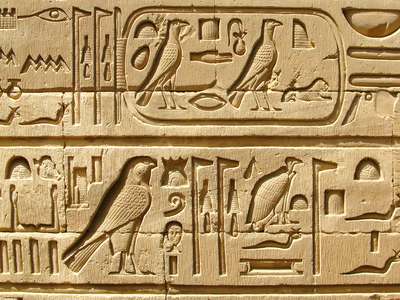
Carved hieroglyphs lining the stone walls of the Temple of Kom Ombo, Egypt, illustrating religious texts and ritual imagery preserved from the Ptolemaic period. - Source
Carved hieroglyphs lining the stone walls of the Temple of Kom Ombo, Egypt, illustrating religious texts and ritual imagery preserved from the Ptolemaic period. - Source
Carved hieroglyphs lining the stone walls of the Temple of Kom Ombo, Egypt, illustrating religious texts and ritual imagery preserved from the Ptolemaic period. - Source
While poetry and prose could articulate anxieties about imperial decline, visual arts faced the challenge of depicting this civilizational collapse in ways that resonated emotionally with Victorian audiences. How do you paint empire's fall in a manner that connects ancient Egyptian collapse to contemporary British concerns?
The Apocalyptic Vision: British painter John Martin's "The Seventh Plague of Egypt" (1823) shows Egypt consumed by biblical plague, fire and hail from blood-red sky while pyramids stand in background. Human figures flee in terror. The architecture, so permanent and proud, offers no protection against divine judgment.
While poetry and prose could articulate anxieties about imperial decline, visual arts faced the challenge of depicting this civilizational collapse in ways that resonated emotionally with Victorian audiences. How do you paint empire's fall in a manner that connects ancient Egyptian collapse to contemporary British concerns?
The Apocalyptic Vision: British painter John Martin's "The Seventh Plague of Egypt" (1823) shows Egypt consumed by biblical plague, fire and hail from blood-red sky while pyramids stand in background. Human figures flee in terror. The architecture, so permanent and proud, offers no protection against divine judgment.
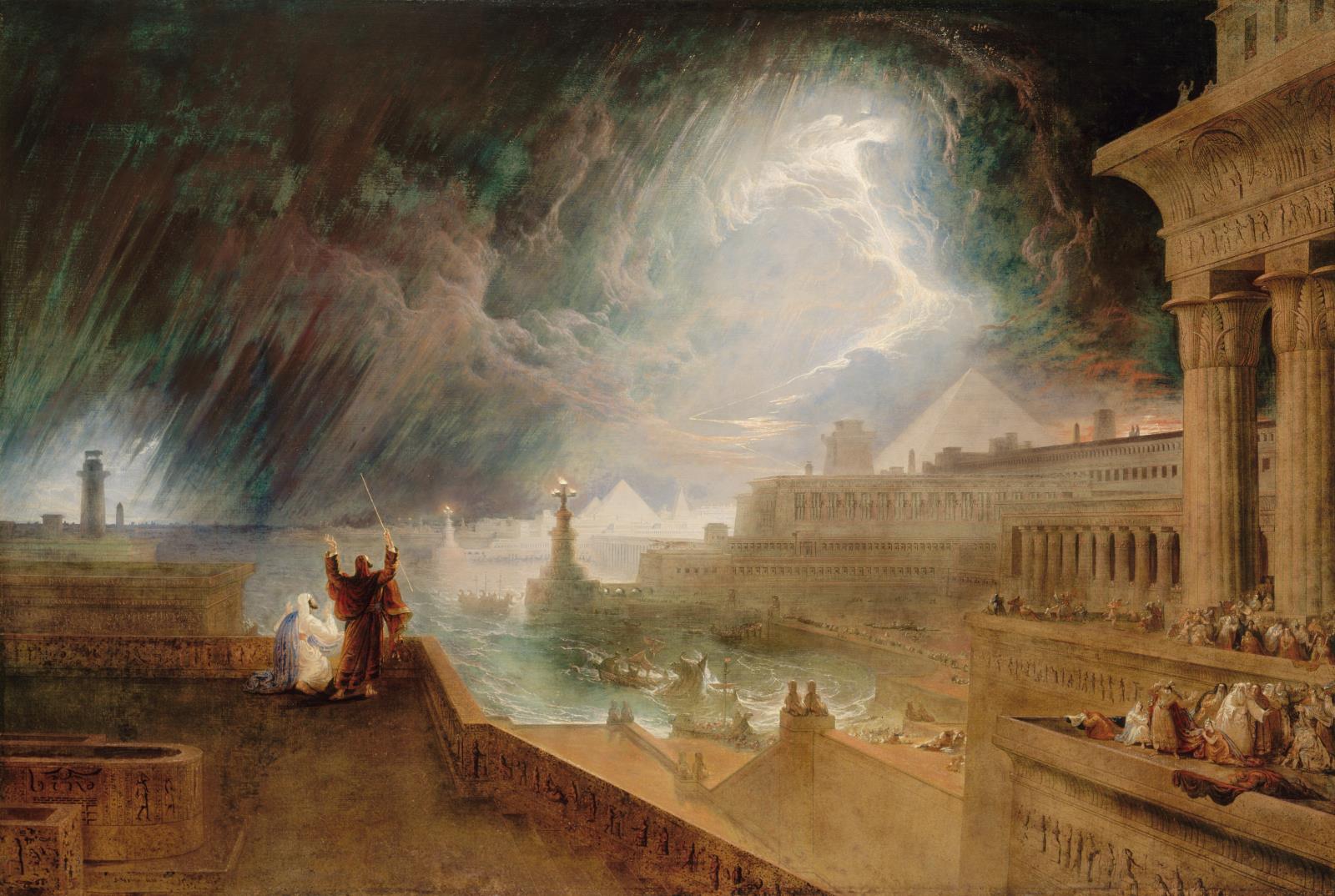
British artist John Martin depicts the biblical plague of Ancient Egypt. Moses is calling down the violent storm of thunder while the Pyramids tower in the backdrop.
British artist John Martin depicts the biblical plague of Ancient Egypt. Moses is calling down the violent storm of thunder while the Pyramids tower in the backdrop.
British artist John Martin depicts the biblical plague of Ancient Egypt. Moses is calling down the violent storm of thunder while the Pyramids tower in the backdrop. - Source
The Sublime aesthetic:
Evokes terror, awe, and sense of the infinite
Humans appear insignificant against vast forces
Beauty mixed with fear
Martin's work solved the visualization problem through the aesthetic category of the Sublime, depicting scenes that inspire simultaneous attraction and terror, beauty and fear. By placing pyramids in apocalyptic biblical scenes, he connected ancient Egyptian monuments to a narrative familiar to Christian Victorian audiences while suggesting that even the most impressive human achievements offer no protection against divine or natural forces. The tiny human figures fleeing in his paintings established scale relationships that made viewers identify with the helpless victims rather than the powerful builders, transforming pyramids from symbols of human achievement into evidence of human limitations. This articulated Victorian anxieties perfectly. No matter how powerful British civilization became, forces beyond human control could destroy it as completely as ancient Egypt fell.
Martin's work articulated Victorian anxieties through Egyptian imagery: all power, no matter how great, is temporary.
The Sublime aesthetic:
Evokes terror, awe, and sense of the infinite
Humans appear insignificant against vast forces
Beauty mixed with fear
Martin's work solved the visualization problem through the aesthetic category of the Sublime, depicting scenes that inspire simultaneous attraction and terror, beauty and fear. By placing pyramids in apocalyptic biblical scenes, he connected ancient Egyptian monuments to a narrative familiar to Christian Victorian audiences while suggesting that even the most impressive human achievements offer no protection against divine or natural forces. The tiny human figures fleeing in his paintings established scale relationships that made viewers identify with the helpless victims rather than the powerful builders, transforming pyramids from symbols of human achievement into evidence of human limitations. This articulated Victorian anxieties perfectly. No matter how powerful British civilization became, forces beyond human control could destroy it as completely as ancient Egypt fell.
Martin's work articulated Victorian anxieties through Egyptian imagery: all power, no matter how great, is temporary.
The United States, as a young nation, faced a unique National Identity Challenge. How to create national symbols suggesting historical depth and legitimate authority when the country lacked ancient history? European nations could reference medieval castles and Roman ruins, but America's short history provided no comparable architectural heritage. The solution involved appropriating ancient symbols and reinterpreting them for republican purposes.
The U.S. adopted pyramid symbolism on currency. The one-dollar bill displays an unfinished pyramid with an eye hovering above, the Great Seal. America used this symbol to position itself as heir to Egypt's power and longevity. Its inclusion is often seen as a nod to the enduring nature of the United States, paralleling the enduring legacy of the Egyptian civilization.
The irony is that this adoption by a democracy inverted what pyramids actually symbolized: autocratic power, divine kingship, rigid hierarchy.
The United States, as a young nation, faced a unique National Identity Challenge. How to create national symbols suggesting historical depth and legitimate authority when the country lacked ancient history? European nations could reference medieval castles and Roman ruins, but America's short history provided no comparable architectural heritage. The solution involved appropriating ancient symbols and reinterpreting them for republican purposes.
The U.S. adopted pyramid symbolism on currency. The one-dollar bill displays an unfinished pyramid with an eye hovering above, the Great Seal. America used this symbol to position itself as heir to Egypt's power and longevity. Its inclusion is often seen as a nod to the enduring nature of the United States, paralleling the enduring legacy of the Egyptian civilization.
The irony is that this adoption by a democracy inverted what pyramids actually symbolized: autocratic power, divine kingship, rigid hierarchy.

The unfinished pyramid on the U.S. one-dollar note, drawn from the reverse of the Great Seal of the United States, symbolizes endurance, rational order, and the project of nation-building as an ongoing construction. Its truncated form suggests a structure still in progress - Source
The unfinished pyramid on the U.S. one-dollar note, drawn from the reverse of the Great Seal of the United States, symbolizes endurance, rational order, and the project of nation-building as an ongoing construction. Its truncated form suggests a structure still in progress - Source
The unfinished pyramid on the U.S. one-dollar note, drawn from the reverse of the Great Seal of the United States, symbolizes endurance, rational order, and the project of nation-building as an ongoing construction. Its truncated form suggests a structure still in progress - Source
This appropriation solved America's legitimacy problem through symbolic transfer. By placing a pyramid on its currency America claimed connection to ancient civilization's power while the unfinished top suggested ongoing progress and perfectibility. The hovering eye represented divine providence watching over the nation, replacing pharaonic divine kingship with more abstract supernatural oversight compatible with Christian democracy. The message to citizens and foreign observers was clear: despite being a young nation, America embodied principles as ancient and enduring as the pyramids.
This appropriation solved America's legitimacy problem through symbolic transfer. By placing a pyramid on its currency America claimed connection to ancient civilization's power while the unfinished top suggested ongoing progress and perfectibility. The hovering eye represented divine providence watching over the nation, replacing pharaonic divine kingship with more abstract supernatural oversight compatible with Christian democracy. The message to citizens and foreign observers was clear: despite being a young nation, America embodied principles as ancient and enduring as the pyramids.
“The same monument can represent divine power, imperial warning, or cultural heritage depending on who's telling the story. It's an enduring architectural symbol because it invites interpretation.”
“The same monument can represent divine power, imperial warning, or cultural heritage depending on who's telling the story. It's an enduring architectural symbol because it invites interpretation.”
Architectural symbols can be completely re-contextualized over time. Egyptian pyramids represented hierarchical society with god-king pharaohs at the apex and masses of subjects at the base, the antithesis of democratic ideals. American reinterpretation stripped away this context, treating the pyramid as a neutral symbol of strength and endurance that could represent any political system.
This demonstrates that architectural meaning is not intrinsic but constructed through interpretation, with symbolic forms becoming available for appropriation once separated from their original cultural contexts.
Architectural symbols can be completely re-contextualized over time. Egyptian pyramids represented hierarchical society with god-king pharaohs at the apex and masses of subjects at the base, the antithesis of democratic ideals. American reinterpretation stripped away this context, treating the pyramid as a neutral symbol of strength and endurance that could represent any political system.
This demonstrates that architectural meaning is not intrinsic but constructed through interpretation, with symbolic forms becoming available for appropriation once separated from their original cultural contexts.
IV. THE SUBLIME AND THE SACRED
IV. THE SUBLIME AND THE SACRED
IV. THE SUBLIME AND THE SACRED
Ordinary buildings can be understood through familiar perceptual frameworks: we gauge size relative to our bodies, assess functionality through mental categories, and evaluate aesthetics through learned preferences. But truly transformative architecture needs to overwhelm these normal perceptual processes, creating experiences that feel extraordinary. The question becomes: what specific architectural strategies reliably trigger responses of awe, wonder, and transcendence?
Ordinary buildings can be understood through familiar perceptual frameworks: we gauge size relative to our bodies, assess functionality through mental categories, and evaluate aesthetics through learned preferences. But truly transformative architecture needs to overwhelm these normal perceptual processes, creating experiences that feel extraordinary. The question becomes: what specific architectural strategies reliably trigger responses of awe, wonder, and transcendence?
The Physiological Impact of Scale
Standing at the Great Pyramid's base creates a specific feeling: breath held, thoughts quiet, confronted by something making you feel simultaneously insignificant and connected to things larger than yourself. Philosophers call this "the Sublime."
What is the Sublime?
Eighteenth-century philosophers sought to explain why certain encounters such as vast landscapes, violent storms, or monumental architecture produced responses fundamentally different from ordinary aesthetic pleasure. These experiences were not simply beautiful. They overwhelmed, unsettled, and compelled attention. Edmund Burke, writing in 1757, defined the Sublime as an affective state combining astonishment, terror, awe, and admiration. Unlike beauty, which invites calm and pleasurable contemplation, the Sublime exerts a kind of force over the viewer. It produces what Burke described as a pleasurable terror, an experience that destabilizes the senses and resists comfort, yet remains irresistible. In Burke’s framework, the defining feature of the Sublime is this tension. Attraction arises precisely from discomfort. Massive architecture, dangerous natural phenomena, and overwhelming artworks become desirable not despite their threat to perceptual ease, but because they push the viewer to the edge of sensory and emotional tolerance.
The Physiological Impact of Scale
Standing at the Great Pyramid's base creates a specific feeling: breath held, thoughts quiet, confronted by something making you feel simultaneously insignificant and connected to things larger than yourself. Philosophers call this "the Sublime."
What is the Sublime?
Eighteenth-century philosophers sought to explain why certain encounters such as vast landscapes, violent storms, or monumental architecture produced responses fundamentally different from ordinary aesthetic pleasure. These experiences were not simply beautiful. They overwhelmed, unsettled, and compelled attention. Edmund Burke, writing in 1757, defined the Sublime as an affective state combining astonishment, terror, awe, and admiration. Unlike beauty, which invites calm and pleasurable contemplation, the Sublime exerts a kind of force over the viewer. It produces what Burke described as a pleasurable terror, an experience that destabilizes the senses and resists comfort, yet remains irresistible. In Burke’s framework, the defining feature of the Sublime is this tension. Attraction arises precisely from discomfort. Massive architecture, dangerous natural phenomena, and overwhelming artworks become desirable not despite their threat to perceptual ease, but because they push the viewer to the edge of sensory and emotional tolerance.
The Physiological Impact of Scale
Standing at the Great Pyramid's base creates a specific feeling: breath held, thoughts quiet, confronted by something making you feel simultaneously insignificant and connected to things larger than yourself. Philosophers call this "the Sublime."
What is the Sublime?
Eighteenth-century philosophers sought to explain why certain encounters such as vast landscapes, violent storms, or monumental architecture produced responses fundamentally different from ordinary aesthetic pleasure. These experiences were not simply beautiful. They overwhelmed, unsettled, and compelled attention. Edmund Burke, writing in 1757, defined the Sublime as an affective state combining astonishment, terror, awe, and admiration. Unlike beauty, which invites calm and pleasurable contemplation, the Sublime exerts a kind of force over the viewer. It produces what Burke described as a pleasurable terror, an experience that destabilizes the senses and resists comfort, yet remains irresistible. In Burke’s framework, the defining feature of the Sublime is this tension. Attraction arises precisely from discomfort. Massive architecture, dangerous natural phenomena, and overwhelming artworks become desirable not despite their threat to perceptual ease, but because they push the viewer to the edge of sensory and emotional tolerance.
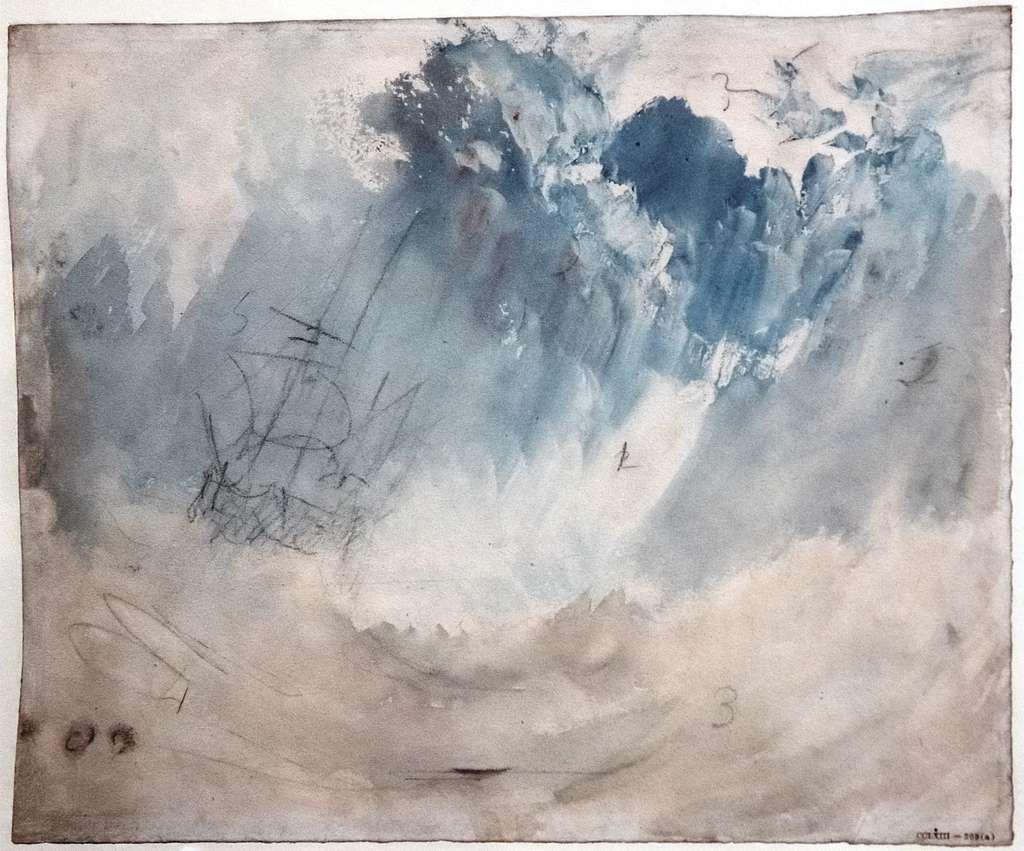
Ship in a storm by J.M. Turner embodies the Romantic sublime: human presence is reduced to fragility as swirling wind, sea, and snow overwhelm the composition, confronting the viewer with nature’s vast, uncontrollable power and the limits of human mastery.
Ship in a storm by J.M. Turner embodies the Romantic sublime: human presence is reduced to fragility as swirling wind, sea, and snow overwhelm the composition, confronting the viewer with nature’s vast, uncontrollable power and the limits of human mastery.
Ship in a storm by J.M. Turner embodies the Romantic sublime: human presence is reduced to fragility as swirling wind, sea, and snow overwhelm the composition, confronting the viewer with nature’s vast, uncontrollable power and the limits of human mastery. - Source
Immanuel Kant, writing in 1790, shifted the discussion from emotional response to cognitive structure. For Kant, the Sublime emerges when the mind confronts something so large or powerful that sensory perception fails altogether. In this moment of failure, reason intervenes. Although we cannot grasp the object fully through sight or sensation, we can comprehend it conceptually as magnitude, infinity, or totality. This transition from sensory inadequacy to rational comprehension produces the Sublime. The experience is humbling because it reveals the limits of the senses, but it is also empowering because it exposes a faculty of thought that exceeds those limits. When we encounter a structure too vast to take in at once, we discover not just the object’s scale, but our own capacity to think beyond immediate perception. In Kant’s account, the Sublime is therefore not located in the object itself, but in the mind’s realization of its own transcendent abilities.
Immanuel Kant, writing in 1790, shifted the discussion from emotional response to cognitive structure. For Kant, the Sublime emerges when the mind confronts something so large or powerful that sensory perception fails altogether. In this moment of failure, reason intervenes. Although we cannot grasp the object fully through sight or sensation, we can comprehend it conceptually as magnitude, infinity, or totality. This transition from sensory inadequacy to rational comprehension produces the Sublime. The experience is humbling because it reveals the limits of the senses, but it is also empowering because it exposes a faculty of thought that exceeds those limits. When we encounter a structure too vast to take in at once, we discover not just the object’s scale, but our own capacity to think beyond immediate perception. In Kant’s account, the Sublime is therefore not located in the object itself, but in the mind’s realization of its own transcendent abilities.
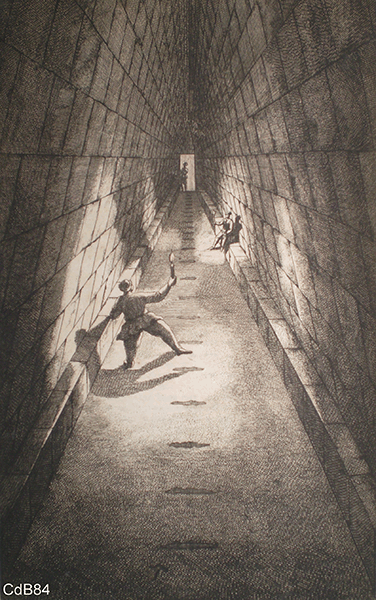
Seventeenth-century engraving depicting the Great Pyramid of Giza, illustrating European archaeological curiosity and travel narratives. Source
Seventeenth-century engraving depicting the Great Pyramid of Giza, illustrating European archaeological curiosity and travel narratives. Source
Seventeenth-century engraving depicting the Great Pyramid of Giza, illustrating European archaeological curiosity and travel narratives. Source
Pyramids as Sublime Objects
Understanding the Sublime as a psychological phenomenon allows us to analyze how pyramids deliberately engineer responses through specific architectural choices. The challenge for pyramid architects was creating forms that reliably trigger Sublime experiences across different viewers and cultural contexts. The solution involved maximizing multiple factors that converge to overwhelm normal perception.
Scale:
Too large to see all at once
Mass that seems impossible (2.3 million blocks)
Height dominating human construction for 4,000 years
Human vision has a finite field of view. Standing at the pyramid's base, you physically cannot see the entire structure without moving. This forces the viewer to mentally reconstruct the whole from partial views, engaging imagination rather than direct perception.
Pyramids as Sublime Objects
Understanding the Sublime as a psychological phenomenon allows us to analyze how pyramids deliberately engineer responses through specific architectural choices. The challenge for pyramid architects was creating forms that reliably trigger Sublime experiences across different viewers and cultural contexts. The solution involved maximizing multiple factors that converge to overwhelm normal perception.
Scale:
Too large to see all at once
Mass that seems impossible (2.3 million blocks)
Height dominating human construction for 4,000 years
Human vision has a finite field of view. Standing at the pyramid's base, you physically cannot see the entire structure without moving. This forces the viewer to mentally reconstruct the whole from partial views, engaging imagination rather than direct perception.
Pyramids as Sublime Objects
Understanding the Sublime as a psychological phenomenon allows us to analyze how pyramids deliberately engineer responses through specific architectural choices. The challenge for pyramid architects was creating forms that reliably trigger Sublime experiences across different viewers and cultural contexts. The solution involved maximizing multiple factors that converge to overwhelm normal perception.
Scale:
Too large to see all at once
Mass that seems impossible (2.3 million blocks)
Height dominating human construction for 4,000 years
Human vision has a finite field of view. Standing at the pyramid's base, you physically cannot see the entire structure without moving. This forces the viewer to mentally reconstruct the whole from partial views, engaging imagination rather than direct perception.
Perfection:
The geometric strategy solves the problem of maintaining impact despite familiarity. Complex forms become comprehensible once you understand their organizing principles, but pure geometric forms like perfect triangles resist this intellectual mastery.
The triangle is simple enough to recognize instantly but perfect enough to feel like an ideal rather than a human-made approximation.
The precision (knife blade cannot fit between blocks) suggests manufacturing tolerances that seem impossible for the stated technological level, creating cognitive dissonance that enhances the Sublime effect.
The simplicity paradoxically makes the achievement more impressive. There are no decorative flourishes to distract from the pure form, forcing viewers to confront the geometric perfection directly.
Perfection:
The geometric strategy solves the problem of maintaining impact despite familiarity. Complex forms become comprehensible once you understand their organizing principles, but pure geometric forms like perfect triangles resist this intellectual mastery.
The triangle is simple enough to recognize instantly but perfect enough to feel like an ideal rather than a human-made approximation.
The precision (knife blade cannot fit between blocks) suggests manufacturing tolerances that seem impossible for the stated technological level, creating cognitive dissonance that enhances the Sublime effect.
The simplicity paradoxically makes the achievement more impressive. There are no decorative flourishes to distract from the pure form, forcing viewers to confront the geometric perfection directly.
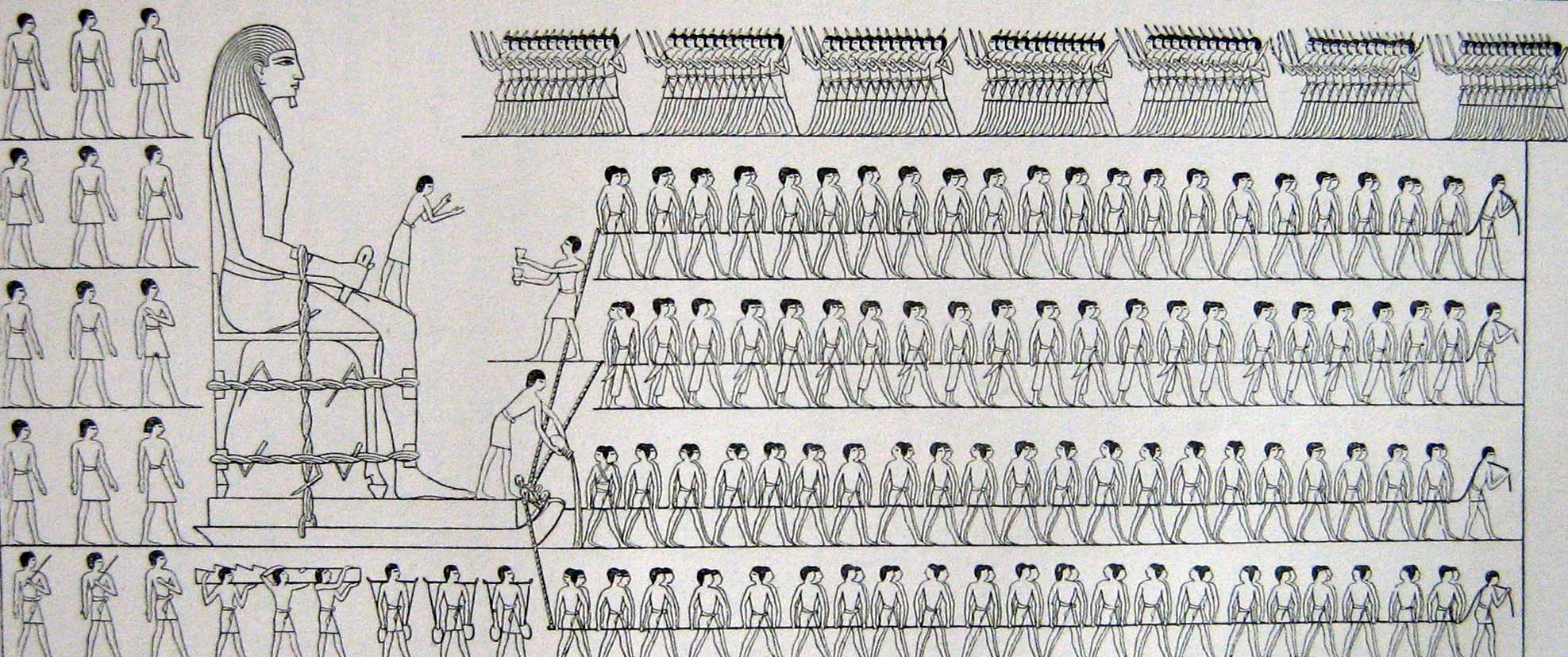
Drawing showing transportation of a colossus. The water poured in the path of the sledge, long dismissed by Egyptologists as ritual, but now confirmed as feasible, served to increase the stiffness of the sand, and likely reduced by 50% the force needed to move the statue.[31]
Drawing showing transportation of a colossus. The water poured in the path of the sledge, long dismissed by Egyptologists as ritual, but now confirmed as feasible, served to increase the stiffness of the sand, and likely reduced by 50% the force needed to move the statue.[31]
Drawing showing transportation of a colossus. The water poured in the path of the sledge, long dismissed by Egyptologists as ritual, but now confirmed as feasible, served to increase the stiffness of the sand, and likely reduced by 50% the force needed to move the statue.[31]
Temporal vastness:
The temporal dimension addresses the problem of creating authority through age. When a structure predates written history and has remained essentially unchanged through the entire span of recorded civilization, it begins to feel like a natural feature of the world rather than a human construction. This temporal scale makes the pyramid feel eternal, suggesting that the power and knowledge behind its construction operate according to principles as fundamental as geological or astronomical forces.
Temporal vastness:
The temporal dimension addresses the problem of creating authority through age. When a structure predates written history and has remained essentially unchanged through the entire span of recorded civilization, it begins to feel like a natural feature of the world rather than a human construction. This temporal scale makes the pyramid feel eternal, suggesting that the power and knowledge behind its construction operate according to principles as fundamental as geological or astronomical forces.
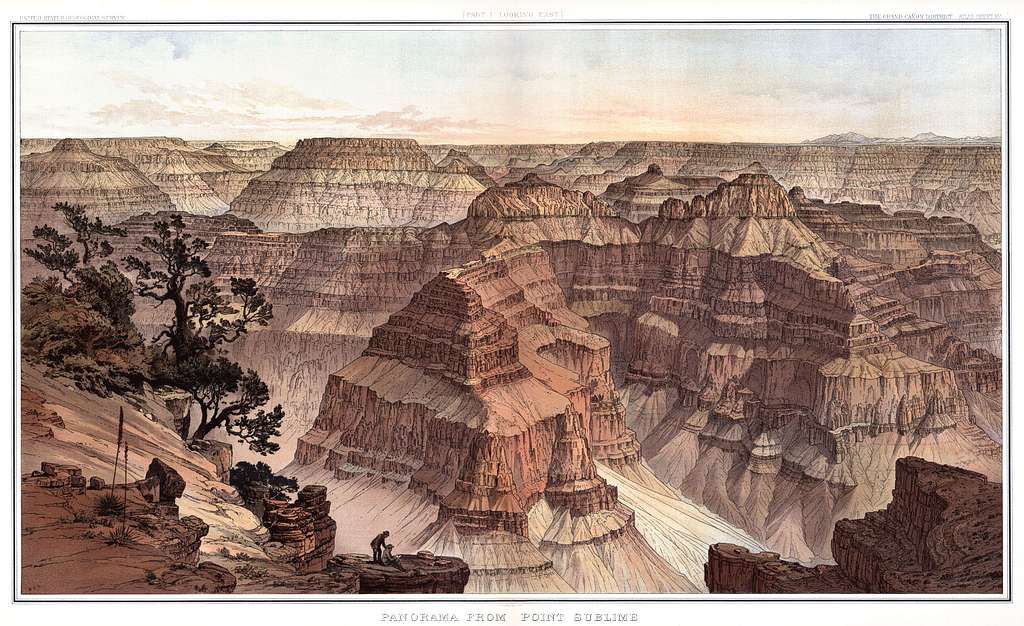
The Grand Canyon evokes the sublime experience through sheer scale and temporal presence. Its vastness exceeds human measure, collapsing distance and time into a single overwhelming view. Image from the Collection of William Henry Holmes - Source
The Grand Canyon evokes the sublime experience through sheer scale and temporal presence. Its vastness exceeds human measure, collapsing distance and time into a single overwhelming view. Image from the Collection of William Henry Holmes - Source
The Grand Canyon evokes the sublime experience through sheer scale and temporal presence. Its vastness exceeds human measure, collapsing distance and time into a single overwhelming view. Image from the Collection of William Henry Holmes - Source
Momentary freezing response:
Brief stillness in posture and breathing
Widened eyes and pupils
Increased attention
Temporary suspension of other cognitive processes
This is the "defense cascade", a mammalian response to perceiving something potentially threatening but not immediately dangerous. It's hypervigilance: body preparing while mind assesses.
Momentary freezing response:
Brief stillness in posture and breathing
Widened eyes and pupils
Increased attention
Temporary suspension of other cognitive processes
This is the "defense cascade", a mammalian response to perceiving something potentially threatening but not immediately dangerous. It's hypervigilance: body preparing while mind assesses.
Physiological Effects of Monumental Architecture
While philosophical frameworks describe the Sublime experience, contemporary neuroscience and psychology face the challenge of measuring these responses objectively and understanding their evolutionary origins.
What specifically happens in human brains and bodies when confronting monumental architecture, and why did these response patterns evolve? Research by Yannick Joye and Siegfried Dewitte shows that when participants viewed images of very tall buildings, they observed:
Physiological Effects of Monumental Architecture
While philosophical frameworks describe the Sublime experience, contemporary neuroscience and psychology face the challenge of measuring these responses objectively and understanding their evolutionary origins.
What specifically happens in human brains and bodies when confronting monumental architecture, and why did these response patterns evolve? Research by Yannick Joye and Siegfried Dewitte shows that when participants viewed images of very tall buildings, they observed:
The freezing response solves an evolutionary problem. When encountering something novel and overwhelming, immediate action (fight or flight) might be inappropriate until better information is gathered? The freeze state allows rapid threat assessment while preparing the body for quick action if needed. With pyramids, the stimulus is too large to represent immediate physical threat (you can't be attacked by a building), but too impressive to ignore as irrelevant. The widened pupils and eyes gather maximum visual information, the attention spike focuses cognitive resources on processing the stimulus, and the suspension of other cognitive processes clears mental bandwidth for assessment. This cascade happens automatically, before conscious thought, making it a powerful tool for architects who understand these triggers.
The freezing response solves an evolutionary problem. When encountering something novel and overwhelming, immediate action (fight or flight) might be inappropriate until better information is gathered? The freeze state allows rapid threat assessment while preparing the body for quick action if needed. With pyramids, the stimulus is too large to represent immediate physical threat (you can't be attacked by a building), but too impressive to ignore as irrelevant. The widened pupils and eyes gather maximum visual information, the attention spike focuses cognitive resources on processing the stimulus, and the suspension of other cognitive processes clears mental bandwidth for assessment. This cascade happens automatically, before conscious thought, making it a powerful tool for architects who understand these triggers.
“Monumental scale triggers physiological and psychological responses: the body freezes, the mind expands. Architecture becomes technology for transcendence.”
“Monumental scale triggers physiological and psychological responses: the body freezes, the mind expands. Architecture becomes technology for transcendence.”
With pyramids, the mind momentarily freezes because the stimulus is too vast to register as an immediate threat yet too impressive to ignore, forcing the brain to pause and categorize the encounter while producing an emotional response that blends fear with fascination.
Buildings triggering this response create memorable experiences. This isn't accidental. It's exactly what architects of sacred and political structures wanted.
With pyramids, the mind momentarily freezes because the stimulus is too vast to register as an immediate threat yet too impressive to ignore, forcing the brain to pause and categorize the encounter while producing an emotional response that blends fear with fascination.
Buildings triggering this response create memorable experiences. This isn't accidental. It's exactly what architects of sacred and political structures wanted.
V. THE SCIENCE OF PERMANENCE
Built to Last Forever
Most human constructions are temporary. Wood rots within decades, steel rusts within centuries, and concrete crumbles after a few generations. Modern buildings are designed with 50-100 year lifespans before requiring major renovation or replacement. The pyramids have stood for 4,500 years with no maintenance, repairs, or modifications, and show no signs of imminent failure. This isn't luck: it's the result of deliberate engineering choices made at every stage of design and construction. The architectural problem becomes: what specific decisions enabled this unprecedented longevity?
Built to Last Forever
Most human constructions are temporary. Wood rots within decades, steel rusts within centuries, and concrete crumbles after a few generations. Modern buildings are designed with 50-100 year lifespans before requiring major renovation or replacement. The pyramids have stood for 4,500 years with no maintenance, repairs, or modifications, and show no signs of imminent failure. This isn't luck: it's the result of deliberate engineering choices made at every stage of design and construction. The architectural problem becomes: what specific decisions enabled this unprecedented longevity?
Built to Last Forever
Most human constructions are temporary. Wood rots within decades, steel rusts within centuries, and concrete crumbles after a few generations. Modern buildings are designed with 50-100 year lifespans before requiring major renovation or replacement. The pyramids have stood for 4,500 years with no maintenance, repairs, or modifications, and show no signs of imminent failure. This isn't luck: it's the result of deliberate engineering choices made at every stage of design and construction. The architectural problem becomes: what specific decisions enabled this unprecedented longevity?
Material Science
Building for permanence requires choosing materials that resist the specific decay mechanisms that destroy most structures. The challenge involves understanding how different stones weather over millennia and selecting materials whose properties align with longevity goals. Cost, workability, and availability must be balanced against durability and resistance to environmental forces.
Strategic Choices:
Limestone (primary building block):
Relatively soft when quarried (easier to shape)
Hardens significantly when exposed to air
Dense enough to resist erosion
Workable with copper tools
Material Science
Building for permanence requires choosing materials that resist the specific decay mechanisms that destroy most structures. The challenge involves understanding how different stones weather over millennia and selecting materials whose properties align with longevity goals. Cost, workability, and availability must be balanced against durability and resistance to environmental forces.
Strategic Choices:
Limestone (primary building block):
Relatively soft when quarried (easier to shape)
Hardens significantly when exposed to air
Dense enough to resist erosion
Workable with copper tools
Material Science
Building for permanence requires choosing materials that resist the specific decay mechanisms that destroy most structures. The challenge involves understanding how different stones weather over millennia and selecting materials whose properties align with longevity goals. Cost, workability, and availability must be balanced against durability and resistance to environmental forces.
Strategic Choices:
Limestone (primary building block):
Relatively soft when quarried (easier to shape)
Hardens significantly when exposed to air
Dense enough to resist erosion
Workable with copper tools
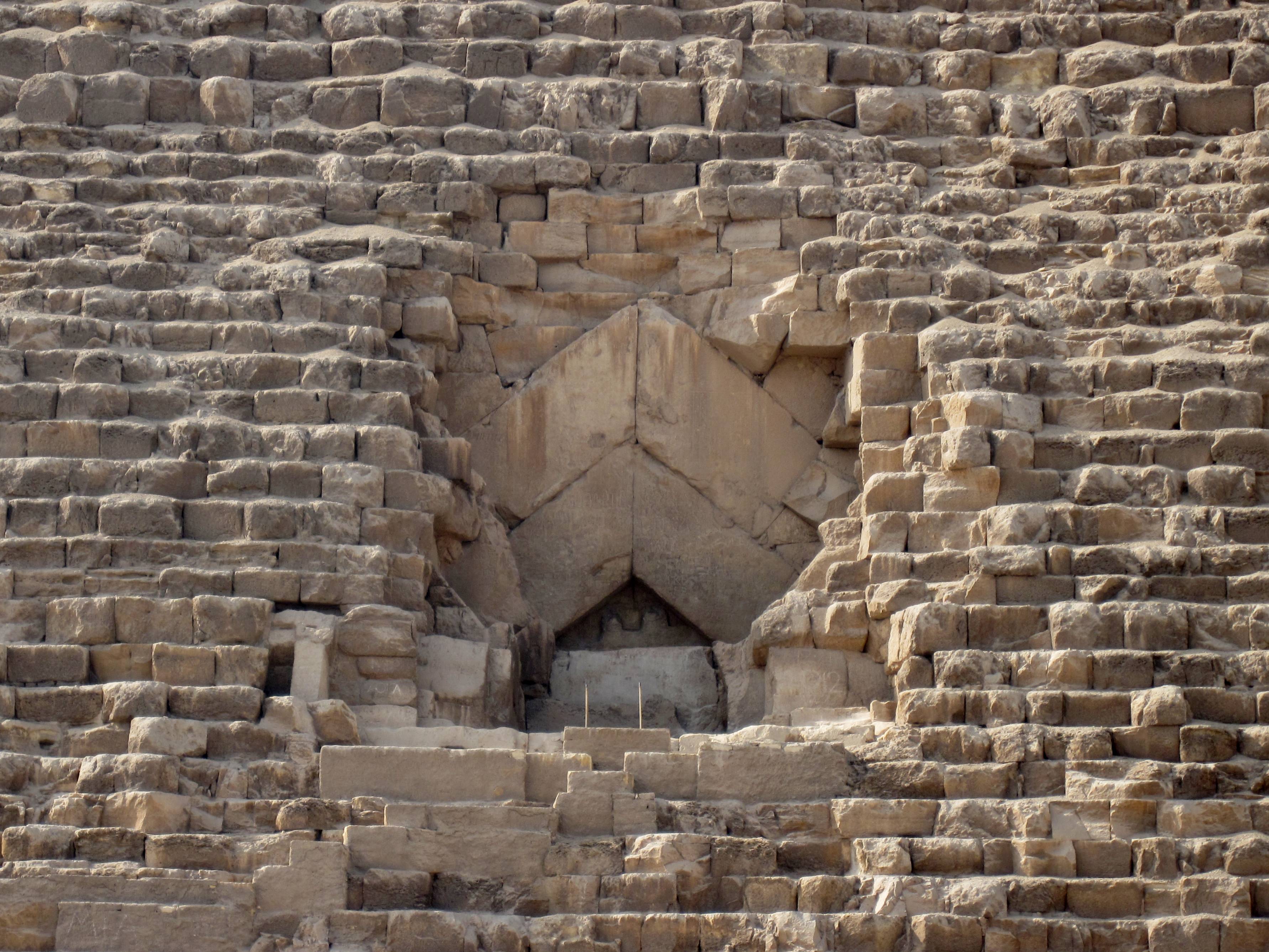
A blocked opening within the Great Pyramid of Giza, where finely cut limestone contrasts with rougher surrounding masonry, showing how precision stonework was used to assert control, durability, and ritual importance, even in concealed or secondary passages. - Source
A blocked opening within the Great Pyramid of Giza, where finely cut limestone contrasts with rougher surrounding masonry, showing how precision stonework was used to assert control, durability, and ritual importance, even in concealed or secondary passages. - Source
A blocked opening within the Great Pyramid of Giza, where finely cut limestone contrasts with rougher surrounding masonry, showing how precision stonework was used to assert control, durability, and ritual importance, even in concealed or secondary passages. - Source
Freshly quarried limestone contains moisture. As it dries and hardens in place, it becomes increasingly durable. The pyramids cured themselves over decades.
The limestone choice solved multiple problems simultaneously. The relative softness when fresh-cut meant workers with copper tools could shape blocks precisely without needing iron or steel tools (which didn't exist yet). The air-hardening property meant the structure became stronger over time rather than weaker, the opposite of most building materials. The density provided sufficient weather resistance without being so hard as to make quarrying and shaping prohibitively difficult. The local availability (quarries near Giza) solved logistics challenges that would have made long-distance stone transport impossible at the required scale. The self-curing property created a structure that improved automatically, with no maintenance required during the decades-long construction process.
Freshly quarried limestone contains moisture. As it dries and hardens in place, it becomes increasingly durable. The pyramids cured themselves over decades.
The limestone choice solved multiple problems simultaneously. The relative softness when fresh-cut meant workers with copper tools could shape blocks precisely without needing iron or steel tools (which didn't exist yet). The air-hardening property meant the structure became stronger over time rather than weaker, the opposite of most building materials. The density provided sufficient weather resistance without being so hard as to make quarrying and shaping prohibitively difficult. The local availability (quarries near Giza) solved logistics challenges that would have made long-distance stone transport impossible at the required scale. The self-curing property created a structure that improved automatically, with no maintenance required during the decades-long construction process.
Freshly quarried limestone contains moisture. As it dries and hardens in place, it becomes increasingly durable. The pyramids cured themselves over decades.
The limestone choice solved multiple problems simultaneously. The relative softness when fresh-cut meant workers with copper tools could shape blocks precisely without needing iron or steel tools (which didn't exist yet). The air-hardening property meant the structure became stronger over time rather than weaker, the opposite of most building materials. The density provided sufficient weather resistance without being so hard as to make quarrying and shaping prohibitively difficult. The local availability (quarries near Giza) solved logistics challenges that would have made long-distance stone transport impossible at the required scale. The self-curing property created a structure that improved automatically, with no maintenance required during the decades-long construction process.
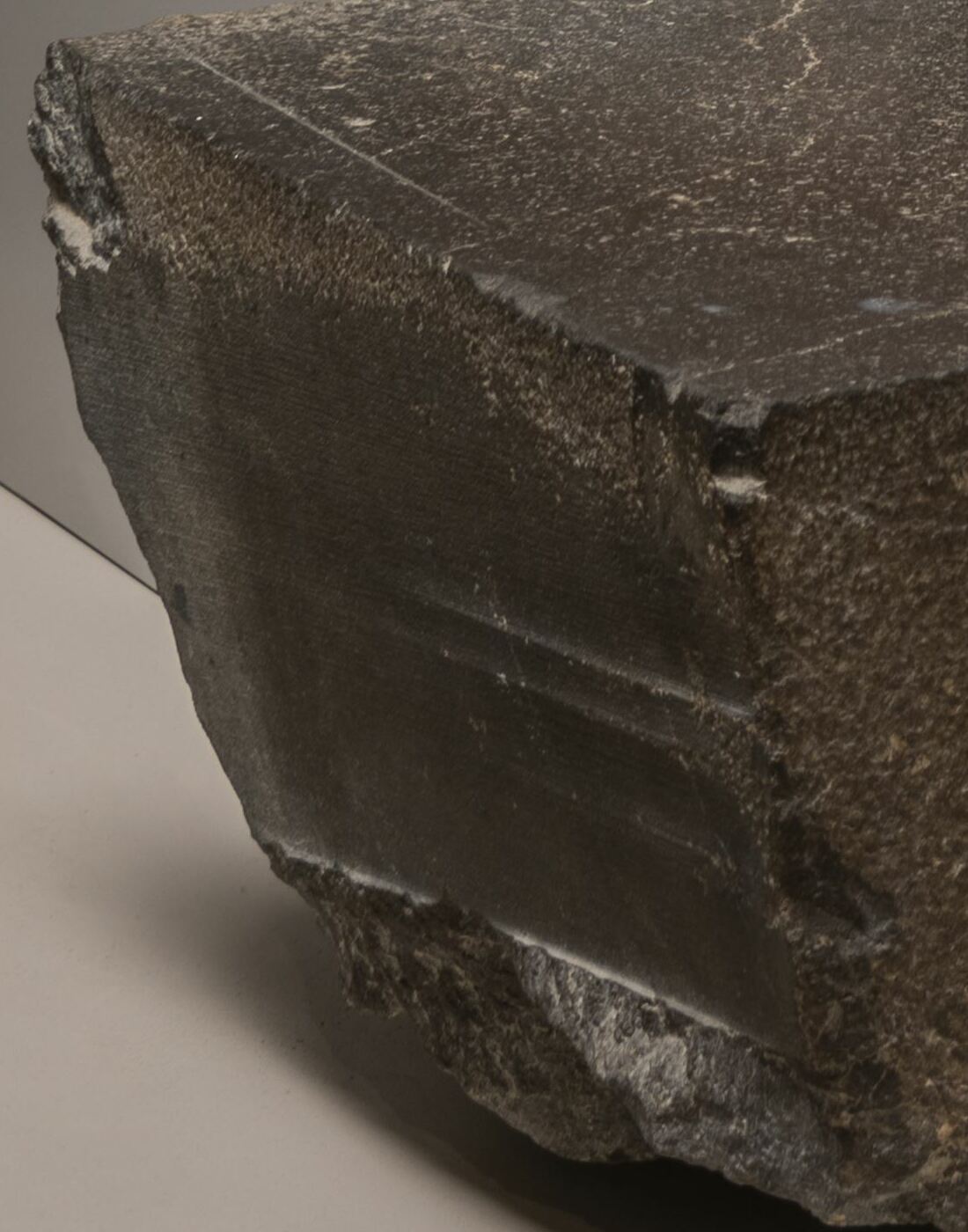
A floor slab from the pyramid temple of Khufu bearing visible saw marks on granite, revealing the advanced stone-cutting techniques and material precision behind Old Kingdom monumentality.
A floor slab from the pyramid temple of Khufu bearing visible saw marks on granite, revealing the advanced stone-cutting techniques and material precision behind Old Kingdom monumentality.
A floor slab from the pyramid temple of Khufu bearing visible saw marks on granite, revealing the advanced stone-cutting techniques and material precision behind Old Kingdom monumentality. Source
Granite: The selective granite use, imported from Aswan which is 500 miles upstream, solved the problem of protecting the most critical interior spaces. While limestone worked for the pyramid's mass, the King's Chamber required material that could span wider distances and bear enormous compression loads without cracking.
The five granite relieving chambers above King's Chamber has prevented collapse for 4,500 years. Granite's extreme hardness and resistance to compression made it ideal for bearing points and large spans, despite the enormous difficulty of transporting 50-ton blocks 500 miles upstream.
The relieving chambers represent sophisticated structural engineering. Stacking five separate chambers above the burial room distributes the millions of tons of overlying weight outward rather than downward, ensuring no compression forces reach the interior space.
This system has performed flawlessly, demonstrating that the architects understood load paths and stress distribution principles that wouldn't be formalized until thousands of years later.
Granite: The selective granite use, imported from Aswan which is 500 miles upstream, solved the problem of protecting the most critical interior spaces. While limestone worked for the pyramid's mass, the King's Chamber required material that could span wider distances and bear enormous compression loads without cracking.
The five granite relieving chambers above King's Chamber has prevented collapse for 4,500 years. Granite's extreme hardness and resistance to compression made it ideal for bearing points and large spans, despite the enormous difficulty of transporting 50-ton blocks 500 miles upstream.
The relieving chambers represent sophisticated structural engineering. Stacking five separate chambers above the burial room distributes the millions of tons of overlying weight outward rather than downward, ensuring no compression forces reach the interior space.
This system has performed flawlessly, demonstrating that the architects understood load paths and stress distribution principles that wouldn't be formalized until thousands of years later.
The Tight-Joint Revolution
Throughout architectural history, the connections between stones have been structures' weakest points. Mortar can crumble, leaving gaps where moisture penetrates. The freeze-thaw cycle—water entering joints, freezing, expanding, and pushing blocks apart—has destroyed countless stone structures. Indeed in most masonry, moisture seeps into joints. When temperatures drop, water freezes and expands, pushing stones apart. Over centuries, this destroys buildings. The engineering challenge was: how do you eliminate joints as potential failure points?
The Egyptian solution: If water can't enter joints, it can't freeze there. The tight-fit strategy eliminated the primary mechanism of stone structure failure.
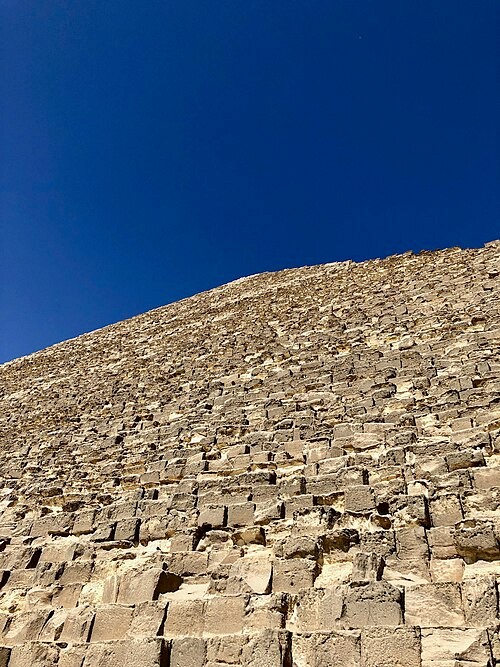
Great Pyramid of Giza, Egypt’s largest pyramid built from limestone blocks, illustrating the monumental stone masonry whose precision and interlocking joints enabled centuries of survival. Source
Great Pyramid of Giza, Egypt’s largest pyramid built from limestone blocks, illustrating the monumental stone masonry whose precision and interlocking joints enabled centuries of survival. Source
Great Pyramid of Giza, Egypt’s largest pyramid built from limestone blocks, illustrating the monumental stone masonry whose precision and interlocking joints enabled centuries of survival. Source
This solution required radically different construction methodology. Rather than rough-cutting blocks at the quarry and filling gaps with mortar on site, Egyptian masons custom-fitted each block to its neighbors through iterative cutting and testing. This meant significantly more labor per block but created a structure where blocks support each other through friction and interlocking rather than adhesive bonding.
The minimal mortar sometimes used functioned as lubricant during placement rather than structural adhesive, allowing blocks to slide into final position before their weight locked them in place. This approach transformed the pyramid from an assemblage of separate stones into a monolithic structure where every block contributes to overall stability.
The water exclusion benefit proved crucial for longevity. While other ancient structures weathered and crumbled as joints opened and closed through freeze-thaw cycles, the pyramid's sealed joints prevented this decay mechanism from ever initiating.
This solution required radically different construction methodology. Rather than rough-cutting blocks at the quarry and filling gaps with mortar on site, Egyptian masons custom-fitted each block to its neighbors through iterative cutting and testing. This meant significantly more labor per block but created a structure where blocks support each other through friction and interlocking rather than adhesive bonding.
The minimal mortar sometimes used functioned as lubricant during placement rather than structural adhesive, allowing blocks to slide into final position before their weight locked them in place. This approach transformed the pyramid from an assemblage of separate stones into a monolithic structure where every block contributes to overall stability.
The water exclusion benefit proved crucial for longevity. While other ancient structures weathered and crumbled as joints opened and closed through freeze-thaw cycles, the pyramid's sealed joints prevented this decay mechanism from ever initiating.
This solution required radically different construction methodology. Rather than rough-cutting blocks at the quarry and filling gaps with mortar on site, Egyptian masons custom-fitted each block to its neighbors through iterative cutting and testing. This meant significantly more labor per block but created a structure where blocks support each other through friction and interlocking rather than adhesive bonding.
The minimal mortar sometimes used functioned as lubricant during placement rather than structural adhesive, allowing blocks to slide into final position before their weight locked them in place. This approach transformed the pyramid from an assemblage of separate stones into a monolithic structure where every block contributes to overall stability.
The water exclusion benefit proved crucial for longevity. While other ancient structures weathered and crumbled as joints opened and closed through freeze-thaw cycles, the pyramid's sealed joints prevented this decay mechanism from ever initiating.
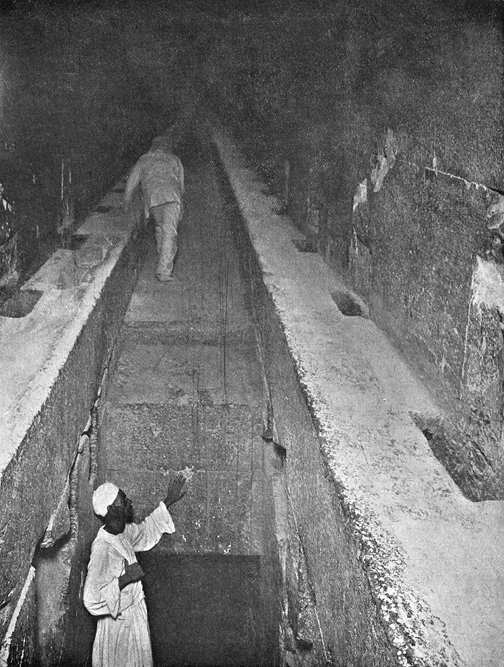
Interior passage of the Great Pyramid of Giza, showing thick limestone walls and enclosed depth that create extreme thermal mass, buffering interior spaces from desert temperature swings year-round. - Source
Interior passage of the Great Pyramid of Giza, showing thick limestone walls and enclosed depth that create extreme thermal mass, buffering interior spaces from desert temperature swings year-round. - Source
Interior passage of the Great Pyramid of Giza, showing thick limestone walls and enclosed depth that create extreme thermal mass, buffering interior spaces from desert temperature swings year-round. - Source
Temperature Regulation
Creating stable interior environments without mechanical systems poses significant engineering challenges, especially in climates with extreme temperature swings. The desert around Giza experiences temperatures from below freezing at night to over 40°C during summer days. This range that would make unprotected interior spaces uninhabitable. How did pyramid architects create stable interior climates using only passive strategies?
The Thermal Mass Solution: The Great Pyramid's interior maintains approximately 20°C (68°F) year-round. Outside, desert temperatures range from below freezing to over 40°C.
The thermal mass strategy solves the climate control problem through physics rather than mechanical systems. Materials with high thermal mass resist temperature change. They absorb heat slowly when temperatures rise and release heat slowly when temperatures fall.
At the pyramid's scale, the millions of tons of stone surrounding interior chambers create such enormous thermal mass that daily temperature swings never penetrate far enough to affect interior spaces. Instead, the interior temperature represents the average of seasonal variations.
They are cool in summer relative to outside, warm in winter. The depth of burial provides additional insulation, with each meter of stone creating more thermal buffering.
This passive system requires no energy input or maintenance while providing more stable conditions than most modern climate control systems. Contemporary architects have rediscovered these principles for earth-sheltered homes and data centers requiring stable temperatures, proving that ancient Egyptian insights into thermal dynamics remain relevant and effective.
Ancient High-Tech
Modern observers often struggle to reconcile the pyramids' precision with their builders' technological limitations. How did ancient Egyptians achieve results that seem to require advanced technology using only simple tools?
Resolving this paradox requires redefining what we mean by "advanced" and recognizing that sophisticated thinking can compensate for simple tools.
The Tool-Thought Relationship:
Advanced technology doesn't require advanced tools. It requires advanced thinking through:
Careful planning
Rigorous quality control
Iterative improvement
Massive resource investment
Willingness to take decades
Ancient High-Tech
Modern observers often struggle to reconcile the pyramids' precision with their builders' technological limitations. How did ancient Egyptians achieve results that seem to require advanced technology using only simple tools?
Resolving this paradox requires redefining what we mean by "advanced" and recognizing that sophisticated thinking can compensate for simple tools.
The Tool-Thought Relationship:
Advanced technology doesn't require advanced tools. It requires advanced thinking through:
Careful planning
Rigorous quality control
Iterative improvement
Massive resource investment
Willingness to take decades
Ancient High-Tech
Modern observers often struggle to reconcile the pyramids' precision with their builders' technological limitations. How did ancient Egyptians achieve results that seem to require advanced technology using only simple tools?
Resolving this paradox requires redefining what we mean by "advanced" and recognizing that sophisticated thinking can compensate for simple tools.
The Tool-Thought Relationship:
Advanced technology doesn't require advanced tools. It requires advanced thinking through:
Careful planning
Rigorous quality control
Iterative improvement
Massive resource investment
Willingness to take decades
Modern construction is faster but often less durable. We've gained efficiency; ancient builders achieved permanence.
This paradox reveals that we conflate tool sophistication with achievement sophistication. Ancient Egyptians lacked power tools, steel, and cranes, but possessed sophisticated understanding of geometry, material properties, and organizational systems. Their achievement came through method rather than machinery. Careful planning that anticipated problems, quality control systems that caught errors early, willingness to invest whatever time and labor necessary to achieve specifications, and institutional structures that maintained standards across decades and generations. Modern construction prioritizes speed and cost-efficiency, accepting shorter lifespans as acceptable trade-offs. Ancient Egyptian priorities were inverted. Longevity mattered more than efficiency, with time and labor considered less precious than achieving eternal structures. This different priority structure enabled achievements we struggle to match despite superior tools, demonstrating that tools alone don't determine capabilities. Goals, methods, and organizational commitment matter equally.
Modern construction is faster but often less durable. We've gained efficiency; ancient builders achieved permanence.
This paradox reveals that we conflate tool sophistication with achievement sophistication. Ancient Egyptians lacked power tools, steel, and cranes, but possessed sophisticated understanding of geometry, material properties, and organizational systems. Their achievement came through method rather than machinery. Careful planning that anticipated problems, quality control systems that caught errors early, willingness to invest whatever time and labor necessary to achieve specifications, and institutional structures that maintained standards across decades and generations. Modern construction prioritizes speed and cost-efficiency, accepting shorter lifespans as acceptable trade-offs. Ancient Egyptian priorities were inverted. Longevity mattered more than efficiency, with time and labor considered less precious than achieving eternal structures. This different priority structure enabled achievements we struggle to match despite superior tools, demonstrating that tools alone don't determine capabilities. Goals, methods, and organizational commitment matter equally.
Modern Archeology
The pyramid's solid stone construction means traditional archaeological investigation methods—excavation and direct observation—risk damaging the structure. Modern archaeology faces the challenge of discovering what's inside pyramids without drilling, cutting, or otherwise compromising their integrity. New technologies offer non-invasive investigation methods that reveal hidden features while leaving structures untouched.
The Scanning Solutions Used:
Cosmic ray muon radiography:
Cosmic ray muons constantly shower Earth from space, penetrating material but being absorbed at rates proportional to density. By placing muon detectors inside known chambers and measuring particle flux from different directions, physicists create three-dimensional density maps revealing voids hidden within solid stone. The 2017 discovery of a previously unknown 30-meter void demonstrates that even intensely studied structures like the Great Pyramid retain secrets.
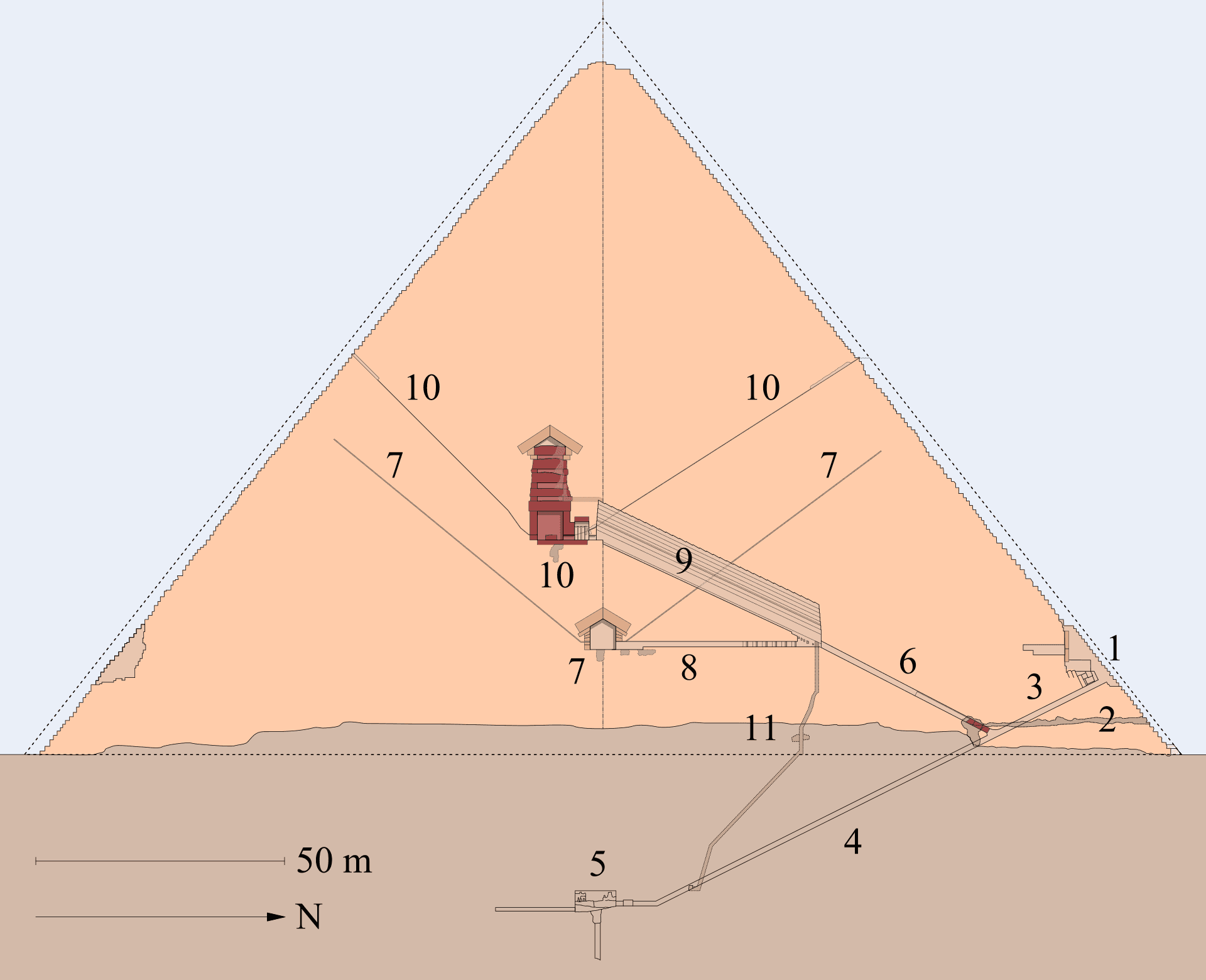
Modern scanning and survey techniques reveal a complete sectional understanding of the Great Pyramid of Giza, exposing its internal passages and voids as a rigorously controlled spatial system rather than a solid mass of stone. - Source
Modern scanning and survey techniques reveal a complete sectional understanding of the Great Pyramid of Giza, exposing its internal passages and voids as a rigorously controlled spatial system rather than a solid mass of stone. - Source
Modern scanning and survey techniques reveal a complete sectional understanding of the Great Pyramid of Giza, exposing its internal passages and voids as a rigorously controlled spatial system rather than a solid mass of stone. - Source
“Longevity through obsessive quality control. The pyramids survive because every design decision, from material selection to joint precision, served permanence.”
Other techniques:
Ground-penetrating radar offers similar non-invasive capability for near-surface features, while thermal imaging detects temperature variations that indicate hidden spaces behind walls. LiDAR creates precise three-dimensional surface models that reveal subtle features invisible to naked-eye observation. These converging technologies ensure that pyramid investigation continues advancing while preserving the structures intact for future generations and study methods we haven't yet invented.
Other techniques:
Ground-penetrating radar offers similar non-invasive capability for near-surface features, while thermal imaging detects temperature variations that indicate hidden spaces behind walls. LiDAR creates precise three-dimensional surface models that reveal subtle features invisible to naked-eye observation. These converging technologies ensure that pyramid investigation continues advancing while preserving the structures intact for future generations and study methods we haven't yet invented.
Other techniques:
Ground-penetrating radar offers similar non-invasive capability for near-surface features, while thermal imaging detects temperature variations that indicate hidden spaces behind walls. LiDAR creates precise three-dimensional surface models that reveal subtle features invisible to naked-eye observation. These converging technologies ensure that pyramid investigation continues advancing while preserving the structures intact for future generations and study methods we haven't yet invented.
VI. SACRED GEOMETRY AND EXACTITUDE
VI. SACRED GEOMETRY AND EXACTITUDE
VI. SACRED GEOMETRY AND EXACTITUDE
The Geometry of the Divine
Ancient architects needed to translate abstract theological concepts and cosmological understanding into physical forms that could teach and reinforce these ideas. The challenge involved encoding spiritual meanings in geometric relationships that would be recognizable while creating structures that functioned. These were architects concerned with not just design buildings, but making them work simultaneously as sacred texts and functional spaces.
The Geometry of the Divine
Ancient architects needed to translate abstract theological concepts and cosmological understanding into physical forms that could teach and reinforce these ideas. The challenge involved encoding spiritual meanings in geometric relationships that would be recognizable while creating structures that functioned. These were architects concerned with not just design buildings, but making them work simultaneously as sacred texts and functional spaces.
The Geometry of the Divine
Ancient architects needed to translate abstract theological concepts and cosmological understanding into physical forms that could teach and reinforce these ideas. The challenge involved encoding spiritual meanings in geometric relationships that would be recognizable while creating structures that functioned. These were architects concerned with not just design buildings, but making them work simultaneously as sacred texts and functional spaces.
Achieving True North Without Compasses
Creating monuments aligned to cardinal directions poses significant technical challenges without magnetic compasses or GPS. Ancient Egyptians needed to establish true north with extraordinary precision to align their pyramids properly. How did the Egyptians determine placement so accurately that the pyramids' are aligned within 1/15th of a degree of the true north?
The Egyptians perfected a five-step astronomical solution.
Build circular wall around flat area
Place observer at center
Mark where circumpolar star rises above wall
Mark where it sets below wall
Bisect angle between points = true north
Achieving True North Without Compasses
Creating monuments aligned to cardinal directions poses significant technical challenges without magnetic compasses or GPS. Ancient Egyptians needed to establish true north with extraordinary precision to align their pyramids properly. How did the Egyptians determine placement so accurately that the pyramids' are aligned within 1/15th of a degree of the true north?
The Egyptians perfected a five-step astronomical solution.
Build circular wall around flat area
Place observer at center
Mark where circumpolar star rises above wall
Mark where it sets below wall
Bisect angle between points = true north
Achieving True North Without Compasses
Creating monuments aligned to cardinal directions poses significant technical challenges without magnetic compasses or GPS. Ancient Egyptians needed to establish true north with extraordinary precision to align their pyramids properly. How did the Egyptians determine placement so accurately that the pyramids' are aligned within 1/15th of a degree of the true north?
The Egyptians perfected a five-step astronomical solution.
Build circular wall around flat area
Place observer at center
Mark where circumpolar star rises above wall
Mark where it sets below wall
Bisect angle between points = true north
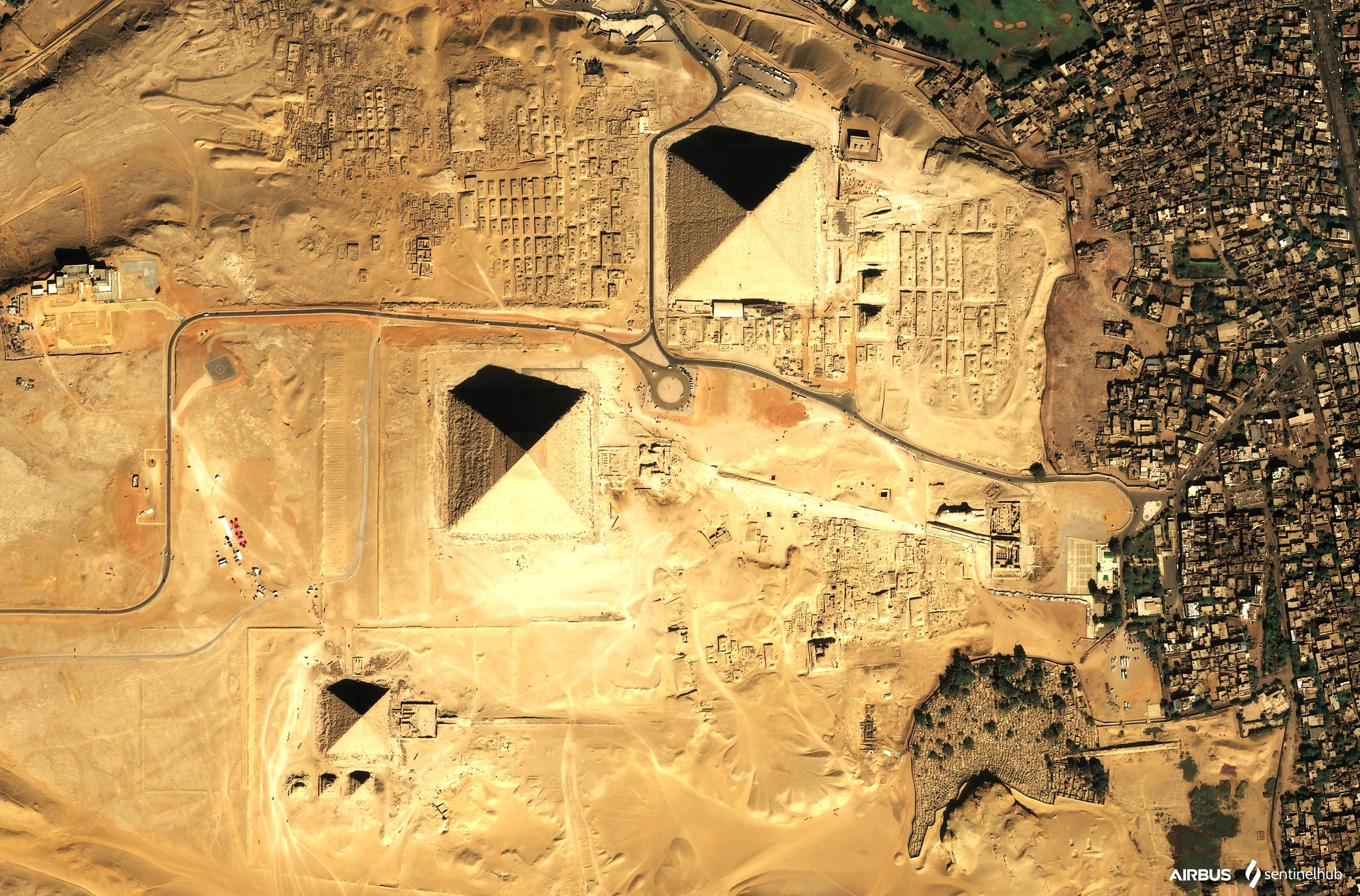
An aerial view of the Giza Plateau reveals the pyramids’ precise alignment to true north, demonstrating an advanced understanding of astronomy and geometry embedded directly into monumental form. - Source
An aerial view of the Giza Plateau reveals the pyramids’ precise alignment to true north, demonstrating an advanced understanding of astronomy and geometry embedded directly into monumental form. - Source
An aerial view of the Giza Plateau reveals the pyramids’ precise alignment to true north, demonstrating an advanced understanding of astronomy and geometry embedded directly into monumental form. - Source
This method relies on the Earth's rotation. Circumpolar stars, which are stars that circle the celestial north pole without setting below the horizon, provide reliable reference points visible throughout the night. By marking where a circumpolar star rises and sets relative to a circular wall, observers establish two points on the star's circular path. The north celestial pole lies at the center of this circular path, and bisecting the angle between the rise and set points identifies the direction toward this pole. The true north.
The genius of this approach lies in how extended observation increases accuracy. The longer you observe, the more complete an arc you trace, making your angle bisection more precise. This turns time into an ally, which would have suited the Egyptians well, who with patient observation over multiple nights yielded a precision that outdid instrument errors of that time.
This method relies on the Earth's rotation. Circumpolar stars, which are stars that circle the celestial north pole without setting below the horizon, provide reliable reference points visible throughout the night. By marking where a circumpolar star rises and sets relative to a circular wall, observers establish two points on the star's circular path. The north celestial pole lies at the center of this circular path, and bisecting the angle between the rise and set points identifies the direction toward this pole. The true north.
The genius of this approach lies in how extended observation increases accuracy. The longer you observe, the more complete an arc you trace, making your angle bisection more precise. This turns time into an ally, which would have suited the Egyptians well, who with patient observation over multiple nights yielded a precision that outdid instrument errors of that time.
This method relies on the Earth's rotation. Circumpolar stars, which are stars that circle the celestial north pole without setting below the horizon, provide reliable reference points visible throughout the night. By marking where a circumpolar star rises and sets relative to a circular wall, observers establish two points on the star's circular path. The north celestial pole lies at the center of this circular path, and bisecting the angle between the rise and set points identifies the direction toward this pole. The true north.
The genius of this approach lies in how extended observation increases accuracy. The longer you observe, the more complete an arc you trace, making your angle bisection more precise. This turns time into an ally, which would have suited the Egyptians well, who with patient observation over multiple nights yielded a precision that outdid instrument errors of that time.
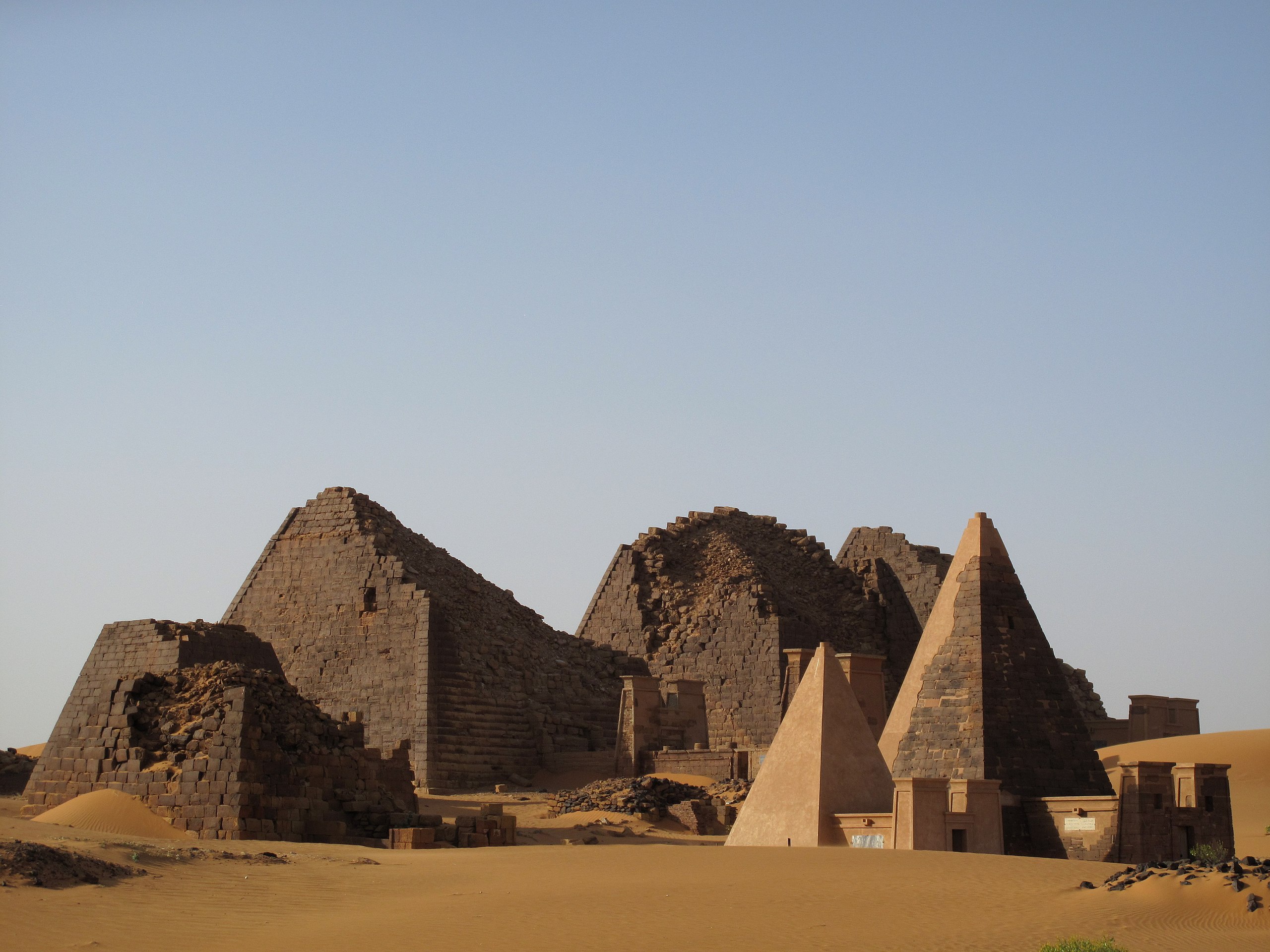
Nubian pyramids at archaeological sites of the Island of Meroe - Source (Ron Van Oers)
Nubian pyramids at archaeological sites of the Island of Meroe - Source (Ron Van Oers)
Nubian pyramids at archaeological sites of the Island of Meroe - Source (Ron Van Oers)
Devotion through Craft
Not all knowledge exists in written or verbal form. Skilled craftspeople possess deep understanding encoded in physical practice. Knowing how to perform complex tasks without being able to fully articulate the rules they're following. This creates challenges for transmitting knowledge across generations and recognizing this tacit understanding as sophisticated knowledge rather than mere manual skill.
How did pyramid builders achieve precision without written formulas or explicit theoretical frameworks?
Philosopher Michael Polanyi coined the term "tacit knowledge". A deep knowledge existing in hands, eyes, intuitions rather than written formulas.
Devotion through Craft
Not all knowledge exists in written or verbal form. Skilled craftspeople possess deep understanding encoded in physical practice. Knowing how to perform complex tasks without being able to fully articulate the rules they're following. This creates challenges for transmitting knowledge across generations and recognizing this tacit understanding as sophisticated knowledge rather than mere manual skill.
How did pyramid builders achieve precision without written formulas or explicit theoretical frameworks?
Philosopher Michael Polanyi coined the term "tacit knowledge". A deep knowledge existing in hands, eyes, intuitions rather than written formulas.
Devotion through Craft
Not all knowledge exists in written or verbal form. Skilled craftspeople possess deep understanding encoded in physical practice. Knowing how to perform complex tasks without being able to fully articulate the rules they're following. This creates challenges for transmitting knowledge across generations and recognizing this tacit understanding as sophisticated knowledge rather than mere manual skill.
How did pyramid builders achieve precision without written formulas or explicit theoretical frameworks?
Philosopher Michael Polanyi coined the term "tacit knowledge". A deep knowledge existing in hands, eyes, intuitions rather than written formulas.
For instance: A master mason’s embodied knowledge includes judging stone quality by sound, sensing levelness by touch alone, visually estimating angles with precision, and understanding structural stability through accumulated experience.
Richard Sennett's "The Craftsman" explains how traditional craftspeople achieved incredible precision through the "intelligent hand" Repeated practice creating deep cognitive understanding embodied in physical skill.
People who cut, transported, and placed millions of blocks developed:
Intuitive understanding of stone properties
Spatial reasoning for fitting irregular blocks
Physical techniques optimized over years
Collective knowledge across generations
The tacit knowledge framework recognizes that the bodies and minds of workers calibrate through practice until they can execute complex tasks consistently and accurately through feel rather than measurement.
For instance: A master mason’s embodied knowledge includes judging stone quality by sound, sensing levelness by touch alone, visually estimating angles with precision, and understanding structural stability through accumulated experience.
Richard Sennett's "The Craftsman" explains how traditional craftspeople achieved incredible precision through the "intelligent hand" Repeated practice creating deep cognitive understanding embodied in physical skill.
People who cut, transported, and placed millions of blocks developed:
Intuitive understanding of stone properties
Spatial reasoning for fitting irregular blocks
Physical techniques optimized over years
Collective knowledge across generations
The tacit knowledge framework recognizes that the bodies and minds of workers calibrate through practice until they can execute complex tasks consistently and accurately through feel rather than measurement.
For instance: A master mason’s embodied knowledge includes judging stone quality by sound, sensing levelness by touch alone, visually estimating angles with precision, and understanding structural stability through accumulated experience.
Richard Sennett's "The Craftsman" explains how traditional craftspeople achieved incredible precision through the "intelligent hand" Repeated practice creating deep cognitive understanding embodied in physical skill.
People who cut, transported, and placed millions of blocks developed:
Intuitive understanding of stone properties
Spatial reasoning for fitting irregular blocks
Physical techniques optimized over years
Collective knowledge across generations
The tacit knowledge framework recognizes that the bodies and minds of workers calibrate through practice until they can execute complex tasks consistently and accurately through feel rather than measurement.
The apprenticeship system: Egyptian projects spanned generations. Young workers learned from masters, practiced for decades, eventually trained next generation. This created institutional knowledge, a sort of collective expertise exceeding any individual's understanding.
The apprenticeship system solved the knowledge transmission problem across generations. Young workers observed masters, attempted tasks under supervision, received feedback, and gradually developed skills through years of practice.
This face-to-face transmission preserved tacit knowledge that couldn't be captured in writing. This created institutional memory and sacred mission embedded in the workforce itself rather than in documents or formal instruction, ensuring that hard-won insights from early construction informed later work even decades after initial lessons were learned.
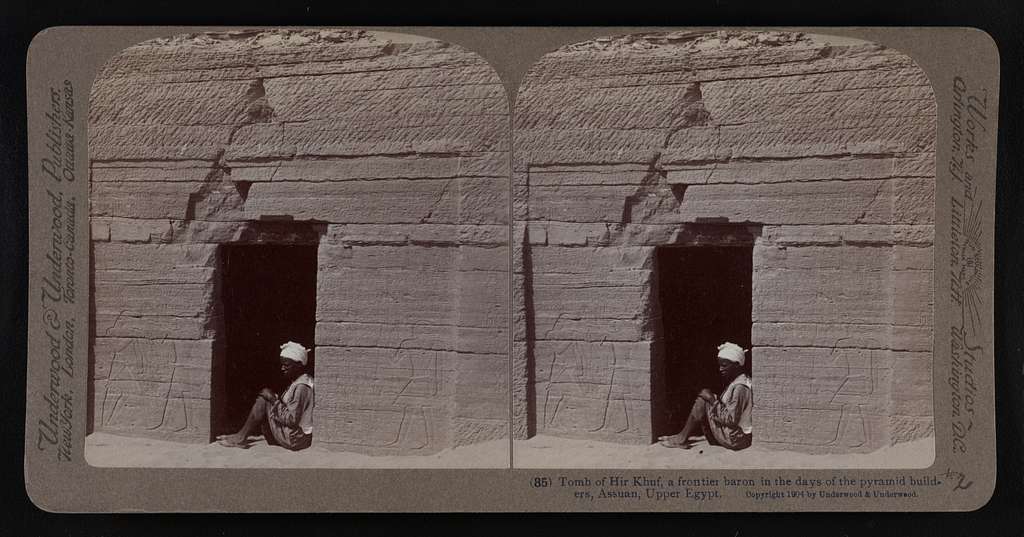
A craftsman at the tomb of Harkhuf, governor of southern Upper Egypt, illustrating the skilled labor and provincial networks that supported pyramid-age state power in Aswan, Upper Egypt. - Source
A craftsman at the tomb of Harkhuf, governor of southern Upper Egypt, illustrating the skilled labor and provincial networks that supported pyramid-age state power in Aswan, Upper Egypt. - Source
A craftsman at the tomb of Harkhuf, governor of southern Upper Egypt, illustrating the skilled labor and provincial networks that supported pyramid-age state power in Aswan, Upper Egypt. - Source
“Precision without high-tech means that the genius is to be found in craftspeople's hands and sophisticated systems, not on paper. Tacit knowledge achieves what written formulas cannot.”
VII. THE MYSTERY INDUSTRIAL COMPLEX
VII. THE MYSTERY INDUSTRIAL COMPLEX
VII. THE MYSTERY INDUSTRIAL COMPLEX
Despite unprecedented archaeological knowledge and technological investigation capabilities, pyramid conspiracy theories are more popular and widespread than ever before. This creates a paradox: increased understanding seems to generate more rather than less mystery. Understanding this phenomenon requires examining the psychological needs these theories fulfill and the cognitive biases that make them compelling despite contradicting evidence.
Despite unprecedented archaeological knowledge and technological investigation capabilities, pyramid conspiracy theories are more popular and widespread than ever before. This creates a paradox: increased understanding seems to generate more rather than less mystery. Understanding this phenomenon requires examining the psychological needs these theories fulfill and the cognitive biases that make them compelling despite contradicting evidence.
Despite unprecedented archaeological knowledge and technological investigation capabilities, pyramid conspiracy theories are more popular and widespread than ever before. This creates a paradox: increased understanding seems to generate more rather than less mystery. Understanding this phenomenon requires examining the psychological needs these theories fulfill and the cognitive biases that make them compelling despite contradicting evidence.
The Psychological Landscape
Despite unprecedented archaeological knowledge, pyramid conspiracy theories are more popular than ever because they satisfy deep psychological needs. Humans are wired for patternicity—our tendency to find meaningful patterns in noise—which makes the Great Pyramid a perfect projection surface: with enough measurements and ratios, almost any pattern can be "discovered," reinforced by confirmation bias and distrust of contradictory evidence.
At the same time, pyramids sit in an ideal information gap: we know enough to be intrigued but not enough to feel closure, making mystery both uncomfortable and addictive. Faced with uncertainty, the mind often prefers a wrong but complete explanation to an incomplete true one, which is why alien or lost-civilization theories feel emotionally satisfying even when they are implausible. They often implicitly racist, denying ancient non-European societies their agency and intelligence.
The Psychological Landscape
Despite unprecedented archaeological knowledge, pyramid conspiracy theories are more popular than ever because they satisfy deep psychological needs. Humans are wired for patternicity—our tendency to find meaningful patterns in noise—which makes the Great Pyramid a perfect projection surface: with enough measurements and ratios, almost any pattern can be "discovered," reinforced by confirmation bias and distrust of contradictory evidence.
At the same time, pyramids sit in an ideal information gap: we know enough to be intrigued but not enough to feel closure, making mystery both uncomfortable and addictive. Faced with uncertainty, the mind often prefers a wrong but complete explanation to an incomplete true one, which is why alien or lost-civilization theories feel emotionally satisfying even when they are implausible. They often implicitly racist, denying ancient non-European societies their agency and intelligence.
The Psychological Landscape
Despite unprecedented archaeological knowledge, pyramid conspiracy theories are more popular than ever because they satisfy deep psychological needs. Humans are wired for patternicity—our tendency to find meaningful patterns in noise—which makes the Great Pyramid a perfect projection surface: with enough measurements and ratios, almost any pattern can be "discovered," reinforced by confirmation bias and distrust of contradictory evidence.
At the same time, pyramids sit in an ideal information gap: we know enough to be intrigued but not enough to feel closure, making mystery both uncomfortable and addictive. Faced with uncertainty, the mind often prefers a wrong but complete explanation to an incomplete true one, which is why alien or lost-civilization theories feel emotionally satisfying even when they are implausible. They often implicitly racist, denying ancient non-European societies their agency and intelligence.
An aerial view of the Giza Plateau reveals the pyramids’ precise alignment to true north, demonstrating an advanced understanding of astronomy and geometry embedded directly into monumental form. - Source
An aerial view of the Giza Plateau reveals the pyramids’ precise alignment to true north, demonstrating an advanced understanding of astronomy and geometry embedded directly into monumental form. - Source
An aerial view of the Giza Plateau reveals the pyramids’ precise alignment to true north, demonstrating an advanced understanding of astronomy and geometry embedded directly into monumental form. - Source
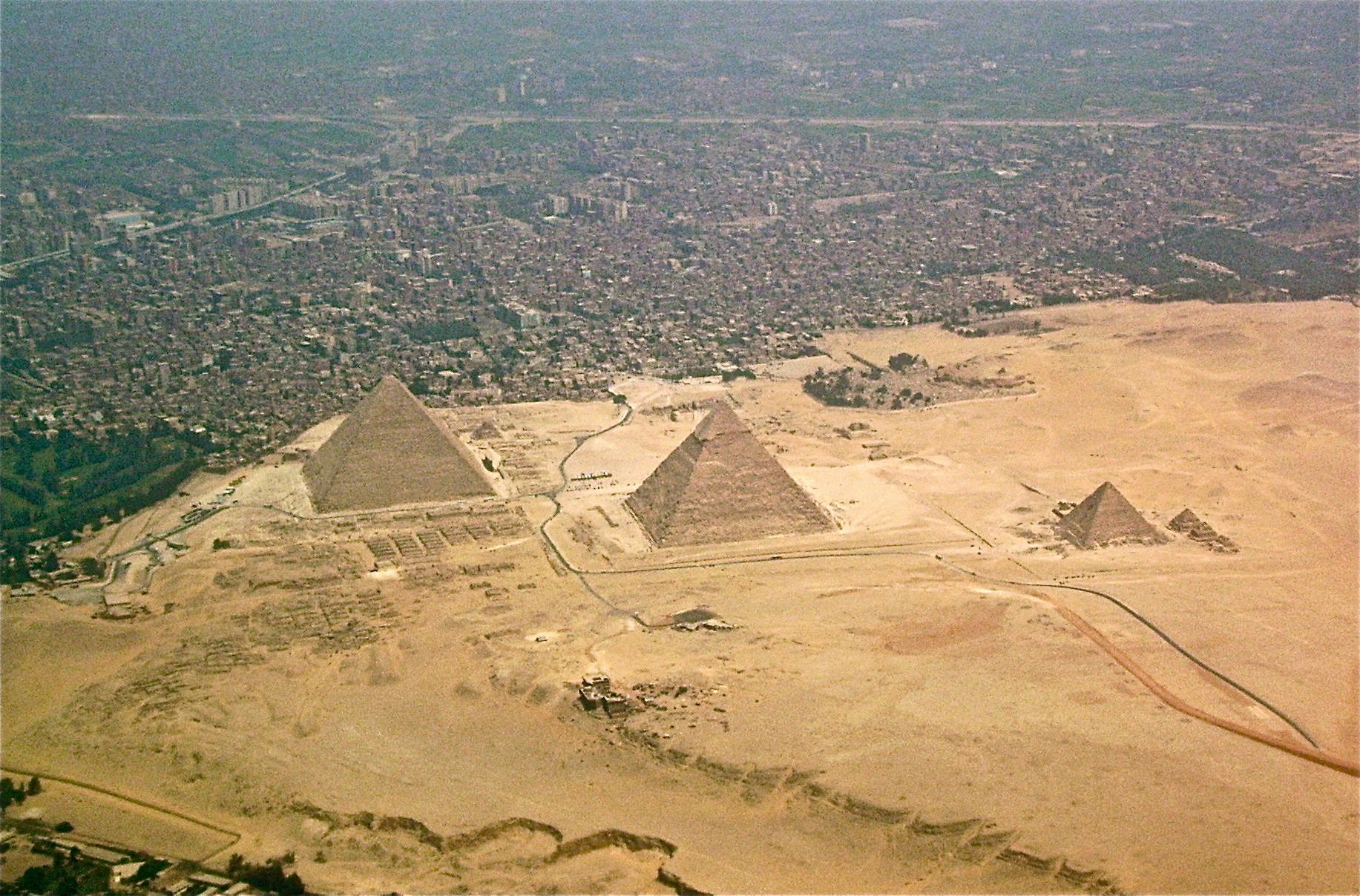
The Giza-pyramids and Giza Necropolis, Egypt, seen from above. Photo taken on 12 December 2008. - Source
The Giza-pyramids and Giza Necropolis, Egypt, seen from above. Photo taken on 12 December 2008. - Source
The Giza-pyramids and Giza Necropolis, Egypt, seen from above. Photo taken on 12 December 2008. - Source
Awe further lowers our critical defenses. Overwhelmed by scale, visitors become hypersuggestible, especially when doubt is introduced and a confident alternative explanation is offered. In an era of algorithm-driven sensationalism and skepticism toward authority, these narratives spread easily.
At the core lies a simple misjudgment: we underestimate what organized humans can achieve over decades with shared purpose, and overestimate the role of advanced technology. The real mystery of the pyramids is not technical precision but social coordination. How tens of thousands sustained quality, discipline, and collective focus across generations.
The unsettling implication is not that ancient people were extraordinary, but that they were entirely ordinary, and that modern societies may have lost the capacity to build with the same long-term unity and permanence.
The Mathematical Intrigue
43,200 is an enigmatic number shows up in many forms. This number appears in sacred architecture worldwide in Hindu cosmology, Babylonian mathematics, precession calculations, ancient calendars.
Consider these calculations:
Seconds in 12 hours = 43,200
43,200 × pyramid height = 3,938.685 miles
Earth's polar radius = 3,949.9 miles (99.7% accurate)
43,200 × pyramid base perimeter = 24,734.94 miles
Earth's equatorial circumference = 24,901 miles (99.3% accurate)
The Egyptians were mathematically minded and build pyramids with precision that signals these relationships. There underlying mathematical mysteries have been a fascination across centuries of study. If the pyramid's construction was fully understood and explainable, they'd lose much of its sublime quality and become merely an impressive historical structure. The numerical relationships that may or may not be intentional create ongoing debate that keeps the pyramid intellectually engaging while preserving its mysterious quality. The fact that we cannot definitively determine the origins of these patterns makes pyramids an ongoing intellectual puzzle.
The Mathematical Intrigue
43,200 is an enigmatic number shows up in many forms. This number appears in sacred architecture worldwide in Hindu cosmology, Babylonian mathematics, precession calculations, ancient calendars.
Consider these calculations:
Seconds in 12 hours = 43,200
43,200 × pyramid height = 3,938.685 miles
Earth's polar radius = 3,949.9 miles (99.7% accurate)
43,200 × pyramid base perimeter = 24,734.94 miles
Earth's equatorial circumference = 24,901 miles (99.3% accurate)
The Egyptians were mathematically minded and build pyramids with precision that signals these relationships. There underlying mathematical mysteries have been a fascination across centuries of study. If the pyramid's construction was fully understood and explainable, they'd lose much of its sublime quality and become merely an impressive historical structure. The numerical relationships that may or may not be intentional create ongoing debate that keeps the pyramid intellectually engaging while preserving its mysterious quality. The fact that we cannot definitively determine the origins of these patterns makes pyramids an ongoing intellectual puzzle.
The Mathematical Intrigue
43,200 is an enigmatic number shows up in many forms. This number appears in sacred architecture worldwide in Hindu cosmology, Babylonian mathematics, precession calculations, ancient calendars.
Consider these calculations:
Seconds in 12 hours = 43,200
43,200 × pyramid height = 3,938.685 miles
Earth's polar radius = 3,949.9 miles (99.7% accurate)
43,200 × pyramid base perimeter = 24,734.94 miles
Earth's equatorial circumference = 24,901 miles (99.3% accurate)
The Egyptians were mathematically minded and build pyramids with precision that signals these relationships. There underlying mathematical mysteries have been a fascination across centuries of study. If the pyramid's construction was fully understood and explainable, they'd lose much of its sublime quality and become merely an impressive historical structure. The numerical relationships that may or may not be intentional create ongoing debate that keeps the pyramid intellectually engaging while preserving its mysterious quality. The fact that we cannot definitively determine the origins of these patterns makes pyramids an ongoing intellectual puzzle.
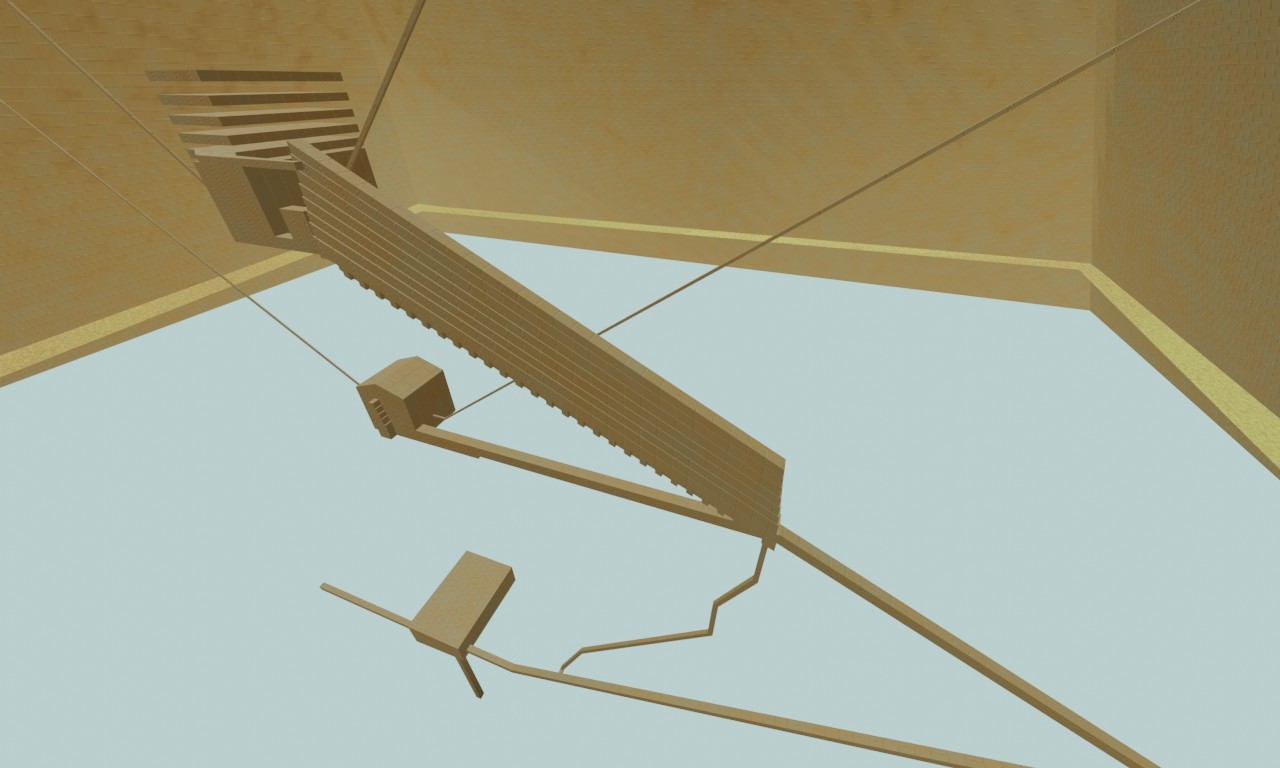
A CC0 screenshot by Drummyfish (2019) showing a 3D rendering of the Great Pyramid’s interior passages and chambers. Source
A CC0 screenshot by Drummyfish (2019) showing a 3D rendering of the Great Pyramid’s interior passages and chambers. Source
A CC0 screenshot by Drummyfish (2019) showing a 3D rendering of the Great Pyramid’s interior passages and chambers. Source
The Spiritual Dimension
Sustaining the level of precision seen in the pyramids over decades of construction required far more than technical knowledge or organizational capacity. It demanded a cultural framework capable of motivating thousands of individuals to maintain exacting standards across generations, even when shortcuts would have been easier and largely invisible. This motivation was rooted first in religion. The pyramid was not simply a tomb but a sacred vessel for the pharaoh’s eternal soul, bound to the maintenance of cosmic order. Imperfection was not a minor flaw but a spiritual failure, a form of disrespect to the gods and a threat to Ma’at, the principle of balance that structured Egyptian understanding of the universe. By making precision a religious obligation rather than a technical preference, pyramid construction elevated every act of labor, from quarrying to stone dressing, into a meaningful contribution to an eternal and divine project.
These religious imperatives were reinforced by broader cultural values and individual pride, creating a motivational system that extended beyond obedience. Egyptian society prized order, discipline, and craftsmanship, treating excellence in one’s role as a moral duty rather than a personal ambition. Skilled labor carried social prestige, and participation in pyramid construction conferred reputational value. This is evident in the graffiti left by work crews deep within the monuments, where teams named themselves and boasted of their skill in spaces never intended for public view. Such marks reveal that workers were not merely complying with authority but investing identity and pride in their work. It is this convergence of sacred purpose, cultural ethics, and human self-recognition that explains why the pyramids continue to invite mythologizing. Although we can point to the various feats of engineering and amass records of a of a successful society, the true achievement of the Pyramids was in their ability to aligned belief, labor, and grant meaning to a society that has remained in the cultural imagination for millennia.
These religious imperatives were reinforced by broader cultural values and individual pride, creating a motivational system that extended beyond obedience. Egyptian society prized order, discipline, and craftsmanship, treating excellence in one’s role as a moral duty rather than a personal ambition. Skilled labor carried social prestige, and participation in pyramid construction conferred reputational value. This is evident in the graffiti left by work crews deep within the monuments, where teams named themselves and boasted of their skill in spaces never intended for public view. Such marks reveal that workers were not merely complying with authority but investing identity and pride in their work. It is this convergence of sacred purpose, cultural ethics, and human self-recognition that explains why the pyramids continue to invite mythologizing. Although we can point to the various feats of engineering and amass records of a of a successful society, the true achievement of the Pyramids was in their ability to aligned belief, labor, and grant meaning to a society that has remained in the cultural imagination for millennia.
“We treat the past as mysterious whenever it exceeds our current sense of capability. The real mystery is not how these structures were built, but why we have lost the collective ability to organize society around the dream of building for permanence. As long as that persists, we will keep mythologizing the Pyramids.”